The New England Patriots achieved a dramatic turnaround in 1 year, capturing the attention of the entire NFL community. From a team that languished in mediocrity, the Patriots soared to improbable heights with a stellar 14-3 record, clinching the AFC East division title for the first time since 2019. Such a comeback is rare, as the Patriots stand as only the third team in NFL history to improve by ten wins from one season to the next.
This remarkable journey is a testament to effective leadership, strategic player acquisitions, and an unwavering team spirit. This turnaround not only reignites hopes for devoted fans but also sets a precedent in NFL lore, further showcasing the Patriots’ enduring legacy and resilience in the sport.

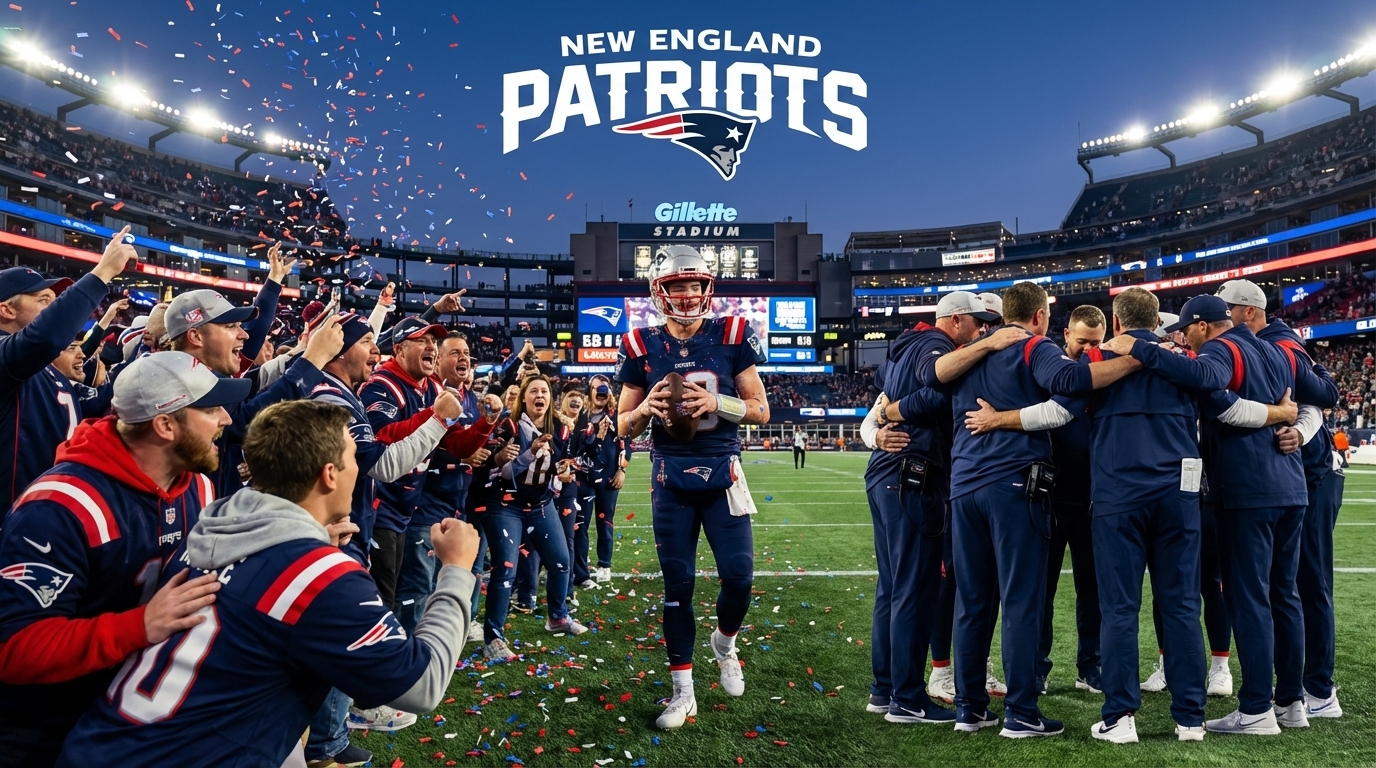
A vivid editorial-style illustration showing the spirit of the Patriots’ comeback, with confetti and a celebrating silhouette in team colors.
Key people behind the Patriots turnaround in 1 year
The Patriots’ revival came from clear leadership and smart personnel moves. Head coach Jerod Mayo set a demanding culture, saying, “People ask what non-negotiables are… Our effort and our finish is going to be the contract that we make with our teammates.” As a result, the locker room bought in to a simple identity. That identity showed up in wins and consistent play across all phases.
Quarterback Drake Maye drove offensive efficiency. He led the league in completion percentage and QBR, and he gave the Patriots reliable, accurate passing. “He’s extremely accurate,” one club source said, and that accuracy translated to 4,393 yards and 31 touchdowns. Because Maye can extend plays with his legs, the offense gained a dangerous dual threat.
The front office leaned on the draft and targeted free agents. Will Campbell and TreVeyon Henderson added immediate blocking and explosiveness. Free agents like Morgan Moses and Milton Williams boosted the line and pass rush, which helped the team grow from 52 sacks allowed last year. Consequently, the pass-block win rate rose to 63 percent, while the run-block win rate climbed to 72 percent.
Coaching strategy also shifted. The offense moved from a West Coast approach to an Erhardt-Perkins system, and Josh McDaniels helped install clearer run concepts and play-action timing. That shift suited Maye and allowed Stefon Diggs to post a 1,000-yard season. Moreover, the defense improved under a tougher stance, featuring Harold Landry and Khyiris Tonga on the edge.
Bill Belichick’s input remained influential behind the scenes. He emphasized preparation and accountability, and players credited that mindset for fewer mistakes. Mike Vrabel added perspective when noting, “We got the right guys in the building at the right time, and we got good quarterback play.” In short, coaching, scouting, and smart signings combined to create a durable, high-performing team.
This mix of leadership and personnel explains why the Patriots surged to a 14-3 record. Therefore, the Patriots turnaround in 1 year feels intentional, and it offers a model of how identity, draft choices, and targeted free agency can reshape a franchise.
2024 vs 2025 Patriots season stats
Below is a quick comparison of key team metrics that highlight the Patriots turnaround in 1 year.
| Metric | 2024 | 2025 | Notes |
|---|---|---|---|
| Points per game | 17.0 | 28.8 | Increase of 11.8 points per game |
| Points allowed per game | Not available | 18.8 | Defense ranked fourth in points allowed |
| Completion percentage | Not available | 72.0% | Drake Maye led the NFL in completion percentage |
| Sack totals | 52 | Higher than 52 | Improved pass rush with Harold Landry and Khyiris Tonga |
| Divisional title | No | Yes | AFC East champions first time since 2019 |
Tactical and statistical improvements that drove the Patriots turnaround in 1 year
The Patriots changed more than personnel to engineer this comeback. Coaches adjusted schemes, scouts upgraded talent, and the players executed. As a result, the team produced clear statistical gains on both sides of the ball.
Offensive uplift and quarterback play
- Points per game jumped from 17.0 to 28.8. That jump created more margin for error and more scoring opportunities late in games.
- Drake Maye supplied elite accuracy and decision making. Coaches noted, “He’s extremely accurate. He’s made the most of every passing opportunity.” As a result, the offense posted 4,393 passing yards and 31 touchdowns.
- The scheme shifted from a West Coast system to Erhardt-Perkins. Consequently, play-action timing and run concepts fit Maye’s strengths. Josh McDaniels helped install clearer reads and more balanced downfield concepts.
- The running game gained life. TreVeyon Henderson and Rhamondre Stevenson delivered clutch yards, and run-block win rate rose to 72 percent per ESPN Analytics.
Defensive improvements and pass rush
- The defense reduced opponent scoring and allowed 18.8 points per game. Therefore, the unit finished fourth in points allowed.
- The pass rush became a true asset. After a season with 52 sacks, the Patriots added depth and production with Harold Landry and Khyiris Tonga. As a result, pressure rates increased and coverage could take more risks.
- Smart free agent moves like Milton Williams added interior strength. Meanwhile, Robert Spillane and the linebackers improved tackling and coverage discipline.
Line play and protection metrics
- Pass-block win rate climbed to 63 percent. Consequently, Drake Maye had more time and more clean throws.
- Run-block efficiency at 72 percent turned short gains into sustainable drives. Because the offensive line controlled the line of scrimmage, third down conversions improved.
Context and caveats
The team benefited from a comparatively easier schedule, with a strength of schedule of 0.391. However, strategic drafting and targeted free agency made those wins sustainable.
Leadership and culture
Jerod Mayo set accountability standards early, saying, “People ask what non-negotiables are… Our effort and our finish is going to be the contract that we make with our teammates.” Bill Belichick’s measured perspective also shaped decisions. As he noted, “In the important decisions in my life, I’ve always said that I measure nine times and cut once and this was one of those situations.” Mike Vrabel captured the broader arc: “We got the right guys in the building at the right time, and we got good quarterback play.”
Taken together, these tactical shifts and statistical improvements explain the Patriots turnaround in 1 year. The metrics show a team that changed identity and then executed that identity consistently.
Conclusion
The Patriots turnaround in 1 year was not accidental. Leadership, personnel moves, and scheme changes created a clear path. Jerod Mayo and the coaching staff set the cultural tone. Bill Belichick’s oversight and Mike Vrabel’s praise reinforced accountability. Because leadership aligned, players bought into a single identity.
Key players delivered when it mattered. Drake Maye’s accuracy and playmaking sparked offensive efficiency. Will Campbell and TreVeyon Henderson improved the line and run game. Free agents like Morgan Moses and Milton Williams added depth. As a result, points per game jumped and protection metrics improved.
Strategic changes made the numbers believable. The shift to an Erhardt-Perkins system fit the quarterback and playmakers. Defensive upgrades and a stronger pass rush tightened games. The team finished 14-3, won the AFC East, and climbed into the No. 2 seed in the AFC. Therefore, the statistical gains backed the narrative.
This turnaround stands as a model of how identity, coaching, and smart roster construction can revive a franchise. For continuous analysis and in-depth coverage of the Patriots’ next steps, follow Patriots Report LLC and on Twitter at @ZachGatsby.
Frequently Asked Questions (FAQs)
What drove the Patriots turnaround in 1 year?
Leadership and schematic change sparked the revival. Jerod Mayo set non negotiables and accountability. Drake Maye supplied elite accuracy and playmaking. The front office drafted Will Campbell and TreVeyon Henderson. Free agent signings like Morgan Moses and Milton Williams improved line play. As a result, the team scored more and protected the quarterback better.
Who were the most impactful players?
Drake Maye led the way with a 72.0 completion rate and 4,393 passing yards. Will Campbell stabilized the line. TreVeyon Henderson added explosiveness. Stefon Diggs returned to 1,000 yards. Harold Landry and Khyiris Tonga improved the pass rush. Meanwhile Andy Borregales provided clutch kicking.
How did coaching changes and scheme shifts help?
The offense moved from West Coast to Erhardt-Perkins, which fit Maye’s strengths. Josh McDaniels tuned play action and run concepts. Jerod Mayo reinforced effort and finish. Bill Belichick offered strategic oversight. Therefore the offense became more balanced and the defense more disciplined.
Were the statistical gains driven by opponent quality?
Partly yes. The strength of schedule was 0.391, which helped. However, points per game rose from 17.0 to 28.8 and defense allowed 18.8 points per game. Pass-block win rate reached 63 percent and run-block 72 percent. Consequently, the numbers reflect real tactical improvement.
What should fans expect next season?
Expect continuity with focus on depth and playoff readiness. The team must sustain quarterback protection and pass rush. If the Patriots keep drafting and signing smartly, they can remain contenders. Overall, the Patriots turnaround in 1 year set a foundation for future success.