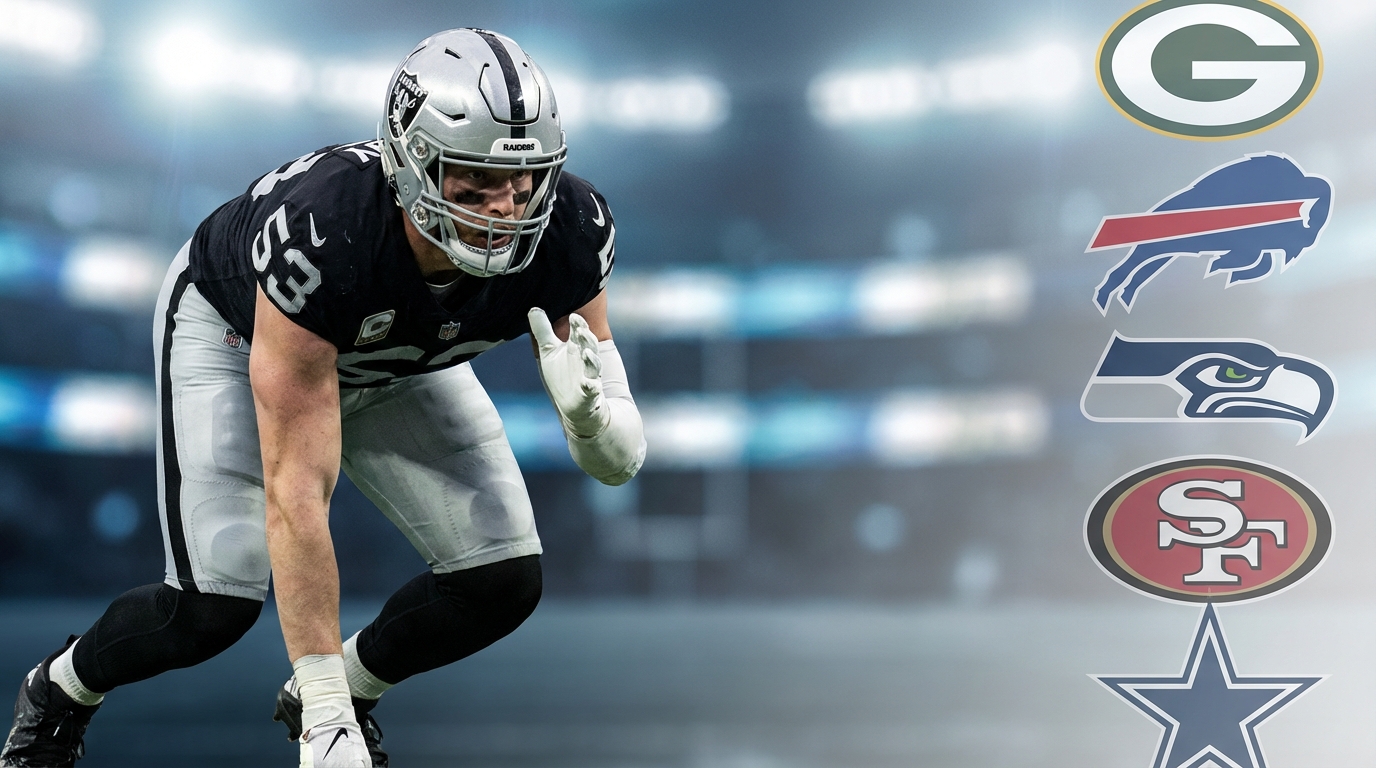
Maxx Crosby trade destinations: 10 realistic landing spots and what each would cost
Maxx Crosby trade destinations are the talk of the offseason. With his blend of production and personality, Crosby draws hungry suitors. However, his three year, $106.5 million extension and recent knee meniscus repair complicate matters. Because of that contract and his injury status, teams must weigh cap math and medical risk before bidding.
League insiders say March could be active, but trading might wait until the April draft. As a result, teams could gather draft capital and build clearer plans before pulling the trigger. Jeremy Fowler and Jay Glazer have both flagged widespread interest, and that chatter matters because Crosby can still command top compensation and premium picks.
This piece analyzes 10 potential landing spots in a focused, team by team format. For each destination, I examine fit, likely cost in picks and salary, cap impacts, and the medical gamble. The coverage blends trade comps, roster need, and realistic timelines, so you can judge which clubs make the most sense.
Keep reading to see where Crosby could land, which franchises should push hardest, and which deals might actually get done.
| Team Name | Cap Space Available | Key Defensive Players | Draft Picks Available | Potential Trade Challenges | Fit Analysis |
|---|---|---|---|---|---|
| Buffalo Bills | Over 60 million in cap space. However a Crosby trade could create a roughly 30 million first year hit for Buffalo. | Von Miller is gone, but the pass rush core includes Gregory Rousseau and Von Miller additions in recent years. Because Buffalo already spends on defense, adding Crosby would boost edge depth. | Multiple first and second round picks should be possible. The Bills have draft flexibility. | The large initial cap hit could complicate their plans. In addition the team must evaluate Crosby medical reports because of his meniscus repair. | High fit because Buffalo wins with a strong pass rush. However salary math makes this a premium decision. |
| Green Bay Packers | High cap space and multiple premium picks likely available. | Rashan Gary and others form a core. Packers also have young defensive pieces and draft capital. | The Packers could offer two first round picks similar to past premium deals. | Green Bay needs to balance giving up picks versus improving Aaron Rodgers era defense or post Rodgers rebuild plans. Also Crosby age factors. | Good schematic fit to rush the passer. Therefore Green Bay could trade big if they push for an elite edge rusher. |
| Seattle Seahawks | Over 60 million in cap space and flexibility to sign top free agents. | Devon Witherspoon anchors the secondary but Seattle needs more front seven help. | The Seahawks can package mid first and future picks. | Medical risk and contract guarantees may give them pause. In addition they must weigh adding cap toward a veteran edge. | Strong fit under Gus Bradley for aggressive pass rush schemes. As a result Seattle ranks as a plausible suitor. |
| San Francisco 49ers | Moderate cap room but significant existing edge salary commitments. Nick Bosa and others push combined edge AAV near 70 million. | Nick Bosa and others already lead the pass rush. | 49ers have some late first and second round capital, plus conditional picks possible. | Adding Crosby would create a heavy salary load at edge. Therefore they must swap premium picks and manage AAV. | Schematic fit is excellent, but salary overlap limits feasibility. They might pursue only if a value trade appears. |
| Dallas Cowboys | Cap position varies, but the Cowboys can create offers with draft currency and player packages. | Micah Parsons and others form a top tier rush. | Dallas could offer premium picks plus player compensation in a trade. | Parsons role and cap structure create redundancy. In addition Jerry Jones may resist high salary overlap. | Low to moderate fit because Parsons already anchors. However the Cowboys could pursue depth for playoff windows. |
| Cincinnati Bengals | Cap space thinner than top spenders, but the Bengals can still trade picks for immediate help around Joe Burrow. | Key players include Joe Burrow and edge needs around the line. | The Bengals could trade future firsts and seconds to win now. | Salary cap and long term contract guarantees make the trade expensive. Also injury risk matters with a veteran edge. | Fit is competitive since Burrow needs more pass rush help. However Cincinnati must weigh cost versus offensive priority. |
| Pittsburgh Steelers | Limited cap but strong defensive culture. The Steelers can move mid round picks and swap players. | T.J. Watt is a centerpiece when healthy. Younger depth includes prospects and rotational pieces. | Pittsburgh could offer mid firsts and future assets. | The team must manage a high salary for Crosby while preserving depth. In addition pairing with Watt raises pay structure concerns. | Fit is tactical and high impact if they can afford the cap hit. Therefore Pittsburgh is a dark horse target. |
| Tennessee Titans | Moderate cap room and a need for consistent pressure off the edge. | Jeffery Simmons and other front seven pieces need complementary rushers. | The Titans could trade second and third round picks for proven help. | Medical status and guaranteed money may limit offers. Also the fit with current scheme needs evaluation. | Schematic fit is solid because Tennessee lacks elite edge help. As a result the Titans could be aggressive if they nudge cap room. |
| Chicago Bears | Rebuilding with draft assets and cap flexibility. They can offer picks and time to rehab Crosby. | Key players include younger pieces and Aidan Hutchinson is a recent high draft pick elsewhere. Chicago still needs veteran edge help. | Bears boast draft currency across several years. They can package picks. | The long term guarantee and Crosby age could create hesitation. Therefore Bears must balance development versus win now moves. | High upside as a bridge veteran for a young defense. They can take a medical risk for future gain. |
| Detroit Lions | Limited need but strong cap willingness historically. Aidan Hutchinson anchors the pass rush. | Aidan Hutchinson and other front seven pieces lead Detroit. | Lions may be less willing to give top picks, but could trade future mid round capital. | Redundancy with Hutchinson and cap balancing issues create challenges. Also Detroit must avoid salary overcrowding at edge. | Lower fit unless the Lions view Crosby as an upgrade or insurance for playoff runs. They may only pursue if price falls. |
Notes
| Raiders trade mechanics | If traded, Crosby would leave with a roughly 5 million dead cap hit to the Raiders. Furthermore a new team could sign him to a four year deal at about 118 million with 59 million guaranteed. |
| Medical note | Crosby had a meniscus repair with trim or repair options. A trim returns him in roughly four to six weeks. A repair can take three to four months to rehab. Teams will weigh these timelines heavily. |
Maxx Crosby trade destinations: Raiders stance and market timing
The Raiders control the narrative because Crosby remains under contract. Their three year, $106.5 million extension includes $62.5 million guaranteed. Because of that deal, a trade would leave Las Vegas with about a $5 million dead cap hit.
League chatter suggests teams will call. Jeremy Fowler said roughly 20 teams could inquire. Meanwhile Jay Glazer flagged that deals might wait until the April draft. Therefore teams can gather picks and make clearer offers.
Key Raiders considerations
- Dead cap hit roughly five million if traded.
- Crosby turns 29 in August, so age enters the evaluation.
- Medical status matters because of a meniscus repair. A trim returns a player in four to six weeks. A repair requires three to four months.
Bills and Packers: cap heavy suitors weighing premium picks
Both Buffalo and Green Bay have enough cap flexibility to interest the Raiders. However each faces unique trade math and roster risk.
Buffalo Bills
- Cap space sits over sixty million, but a Crosby trade could create an initial roughly thirty million hit.
- The Bills already focus on defensive spending and pass rush depth.
- As a result, Buffalo fits schematically, but salary timing complicates a move.
Green Bay Packers
- The Packers likely hold high cap room and premium draft capital.
- Past comps show teams pay heavily for elite edge rushers, like the Micah Parsons deal.
- Therefore Green Bay could offer two first rounders or a similar package.
Seahawks and 49ers: scheme fit versus salary overlap
Seattle and San Francisco both make sense schematically. However they differ on cap flexibility and internal salaries.
Seattle Seahawks
- Seattle reportedly has over sixty million in space and strong draft flexibility.
- Gus Bradley’s scheme thrives on downfield pressure and versatile edges.
- However teams will weigh Crosby’s guarantees and meniscus timeline before committing picks.
San Francisco 49ers
- The 49ers boast elite pass rush talent led by Nick Bosa.
- Yet adding Crosby would push combined edge average annual salary toward seventy million.
- Therefore San Francisco faces a tradeoff between premium picks and heavy payroll.
Across these teams, expect intensive medical checks, draft timing negotiation, and premium offers. Because interest runs deep, Crosby’s market should command both assets and salary clarity.
Contract specifics and injury implications
Maxx Crosby’s contract drives trade leverage and financial planning. The Raiders gave him a three year, $106.5 million extension last May. That deal includes $62.5 million fully guaranteed now. In addition, he carries $29 million in guarantees that become payable in March 2027.
If Las Vegas trades Crosby, the Raiders absorb about a $5 million dead cap hit. However, a receiving team could restructure a new deal. A four year, $118 million contract with $59 million guaranteed is a practical market target. Therefore, teams must internalize both the current guarantees and possible new guarantees.
Key contract facts
- Extension length and value: three years, $106.5 million.
- Current guarantees: $62.5 million today.
- Future guarantees: $29 million due in March 2027.
- Raiders dead cap if traded: roughly $5 million.
- Market projection for a new team: about four years, $118 million, $59 million guaranteed.
Injury status and recovery timelines
Crosby underwent a meniscus repair in his knee. Teams view two common surgical paths. A trim allows a four to six week return. Alternatively, a full repair demands three to four months of rehab. Consequently, medical teams will rank offers based on expected availability.
How contract and injury change trade talks
- Price and timing shift because cap hits and guarantees matter.
- Teams with high cap space face a large first year hit, so they may prefer April timing.
- Jeremy Fowler noted about 20 teams could call, which increases competition.
- Jay Glazer suggested deals might wait until the April draft for clearer trade chips.
- Historical comps show teams pay top picks for elite edge pass rushers, which raises Crosby’s floor.
As a result, expect heavy medical checks, delayed negotiations, and premium pitch offers. Teams will weigh short term availability versus long term value, and that calculus will decide Crosby’s final landing spot.
Conclusion: What the market looks like for Maxx Crosby
Maxx Crosby’s trade market balances clear value and clear risk. His production and edge skill make him a premium target. However his three year, $106.5 million extension and guaranteed money complicate trades.
Teams with heavy cap space can absorb the initial hit. Therefore Buffalo, Seattle, and Green Bay appear as top fits. Yet the 49ers face salary overlap, and contenders like Dallas or Cincinnati must weigh roster priorities. Because Crosby recently had a meniscus repair, medical timelines will shape offers. A trim speeds return in four to six weeks. A repair delays availability for three to four months.
Trade timing matters. Jeremy Fowler’s reporting suggests about 20 teams will call. Meanwhile Jay Glazer says clubs may wait until the April draft. As a result, expect offers to change as teams gather picks and clear cap room.
In sum, Crosby should command premium draft capital and a market-level extension. Teams will trade aggressively only after medical clarity and draft timing align. For ongoing analysis, this piece was produced by Patriots Report LLC. Website patriotsreport.com and Twitter @ZachGatsby provide updates and further coverage.
Frequently Asked Questions (FAQs)
Will Maxx Crosby be traded?
Interest is real but a trade is not guaranteed. ESPN’s Jeremy Fowler says about 20 teams could call. Meanwhile Jay Glazer suggests clubs may wait until the April draft. Therefore expect heavy pre-draft chatter and possible delayed deals.
How does Crosby’s contract affect trade talks?
Crosby signed a three year, $106.5 million extension last May. He has $62.5 million guaranteed now and $29 million in guarantees due in March 2027. If traded, the Raiders absorb about a $5 million dead cap hit. A new team could structure roughly four years and $118 million with $59 million guaranteed. As a result, guarantees and cap timing will shape offers.
How does the knee injury change his market value?
Crosby had a meniscus repair. A trim returns a player in four to six weeks. A full repair needs three to four months. Consequently teams will perform detailed medical checks. Short term availability will lower some bids, while long term value remains strong.
Which teams are the top suitors?
Buffalo, Green Bay, and Seattle have cap room and draft assets. The 49ers fit schematically but face salary overlap at edge. Other contenders include Cincinnati, Dallas, and Pittsburgh. Ultimately team needs and cap math decide.
What haul should the Raiders expect?
Expect premium compensation. Historical comps show two first round picks plus assets for elite edges. Therefore anticipate first round capital, conditional picks, or player packages.