
Will Campbell Prove ESPN Wrong on All-Rookie?
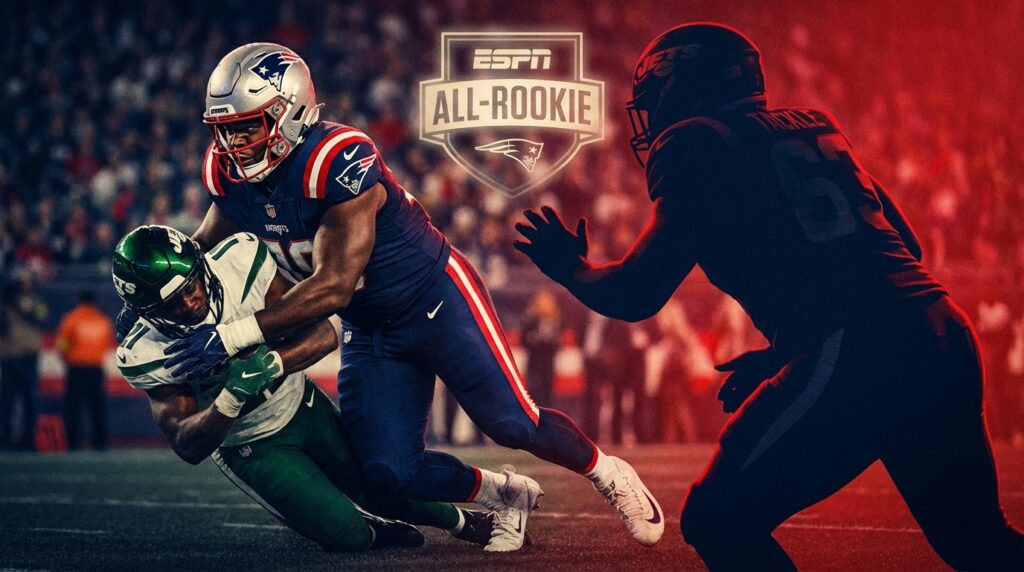
Will Campbell — Patriots’ No. 4 Pick and the All-Rookie Omission
Will Campbell entered his rookie year as a lightning rod for debate among Patriots fans. Selected fourth overall by New England, Campbell quickly turned heads with his play. ESPN’s decision to exclude him from its All-Rookie Team ignited controversy. That controversy matters because it raises questions about evaluation methods.
A closer look at the tape and metrics shows why New England staffers remain confident. Campbell posted a 5.5% pressure rate and committed seven penalties in 12 games. By contrast, Kelvin Banks recorded a 6.8% pressure rate and more penalties in more snaps. Campbell also returned from IR and arguably played better despite fewer snaps.
This debate matters because it frames how analysts value draft capital and production. Therefore the All-Rookie omission reveals as much about evaluative bias as it does about a résumé. Ultimately, Patriots fans should view Campbell’s rookie body of work as encouraging evidence. In this article we analyze film, metrics, and context to judge whether ESPN missed the mark.

Will Campbell Performance Analysis and Metrics
The rookie season of Will Campbell delivered both promise and measurable production. The Patriots invested the fourth overall pick in him, and he answered with play that justified the pick. Because he missed time on injured reserve, Campbell logged fewer snaps. However, his efficiency metrics still stand out. That efficiency is central to the case that ESPN undervalued him.
Key Campbell metrics
- Pressure rate 5.5 percent over his rookie snaps, showing strong pass protection effectiveness.
- Penalties seven in 12 games, which is modest given his snap count and role.
- Sacks allowed five total, matching the comparable rookie in this debate.
- Activated off injured reserve and returned to contribute down the stretch, which demonstrates resilience and availability.
How those numbers compare to Kelvin Banks
- Kelvin Banks posted a 6.8 percent pressure rate, which is higher than Campbell and suggests more quarterback disruption.
- Banks recorded 10 penalties in 17 games, indicating more procedural or technique issues across more playing time.
- Banks also allowed five sacks and had one game with multiple sacks, the same as Campbell.
- Banks enjoyed a larger sample size because he stayed on the field more often, so raw totals skew in his favor.
Why the comparison matters
- Because pressure rate is a rate based metric, it isolates protection quality independent of snaps. Therefore Campbell looks better on a per play basis.
- Even though Banks played more, Campbell has arguably been better when on the field. As a result the All Rookie omission deserves scrutiny.
- Penalty rates favor Campbell when adjusted for games and snaps, which reduces the narrative that Campbell is a liability.
- Both players allowed the same number of sacks, so the difference comes down to efficiency and context rather than glaring weakness.
For additional context on this debate see these Patriots Report pieces that examine the head to head analysis and pick value: Will Campbell vs. Kelvin Banks Debate, Will Campbell All Rookie Pick. Also consider how broader team decisions shape usage in late season matchups: Bills Rest Josh Allen WK 18.
Will Campbell vs Kelvin Banks — Key Rookie Stats
| Statistic | Will Campbell (Patriots) | Kelvin Banks (Saints) |
|---|---|---|
| Draft pick | 4th overall | 9th overall |
| Pressure rate | 5.5% | 6.8% |
| Penalties | 7 in 12 games | 10 in 17 games |
| Games played | 12 | 17 |
| Sacks allowed | 5 | 5 |
| Multiple-sack games | 1 | 1 |
| IR activation | Activated off IR (returned) | Not reported on IR |
Because Campbell logged fewer snaps, his rate metrics carry extra weight.
Will Campbell and ESPN’s All-Rookie Omission
ESPN analyst Ben Solak chose Kelvin Banks over Will Campbell for the All-Rookie Team. That decision sparked debate because the underlying metrics complicate a simple call. Banks played more snaps, yet Campbell often looked cleaner on a per play basis. As a result, the omission raises questions about how voters weigh sample size versus efficiency.
Industry standards matter in this debate. The industry standard is that tackles allow the highest pressure rate, followed by guards, then centers. Therefore raw pressure numbers need context by position. Campbell posted a 5.5 percent pressure rate while Banks posted 6.8 percent. Because Campbell logged fewer snaps, his lower rate suggests stronger pass protection on a per play basis.
Sample size also shapes perception. “Banks has played more than Campbell has, but Campbell has arguably been better,” as some evaluators noted. It is understandable to give Banks the edge when you value volume. However that approach can obscure efficiency and situational impact. “It’s understandable to give Banks the edge if you put a premium on sample size, but it’s hard not to be pleased with what Campbell has shown.” This line of thinking favors Campbell when you emphasize rate metrics.
Context beyond numbers matters as well. Both rookies allowed five sacks and had one multi-sack game. Campbell returned from injured reserve and contributed late. Because he showed resilience and lower penalty rates per snap, the case for Campbell grows stronger. Therefore the All-Rookie omission looks less like clear judgment and more like a preference for larger samples. In short, fans and analysts should weigh per play efficiency as heavily as raw totals.
Conclusion
Will Campbell’s rookie season validated the Patriots’ No. 4 pick despite ESPN’s All-Rookie omission. Because his rate metrics favored efficiency, his play mattered when it counted. Therefore the omission does not erase the on-field value New England gained.
Campbell returned from injured reserve and helped stabilize the offensive line during crunch time. He posted a 5.5% pressure rate and logged seven penalties in 12 games. By contrast Kelvin Banks logged a 6.8% pressure rate across more snaps. However both rookies allowed five sacks and showed room for growth.
The key takeaway is context. Because Campbell produced better per play numbers, he strengthened the Patriots’ roster. Moreover his return contributed to the team’s late season momentum. As a result the pick worked even without All-Rookie recognition.
Fans should weigh efficiency, position context, and resilience more than awards. In short, ESPN’s omission reflects evaluative preferences more than clear superiority. Patriots decision makers earned credit for selecting a player who improved their offensive line.
For further analysis visit Patriots Report LLC. Follow updates on Twitter at @ZachGatsby.
Frequently Asked Questions (FAQs)
Was Will Campbell unfairly left off ESPN’s All-Rookie Team?
Not necessarily unfair, but debatable. ESPN analyst Ben Solak selected Kelvin Banks. However sample size influenced that choice. Banks played more snaps, and voters often reward volume. Yet Campbell posted a lower pressure rate and better penalty rate per snap. Therefore many fans view the omission as an evaluative preference, not a clear snub.
How do Will Campbell’s rookie numbers stack up against Kelvin Banks?
Campbell posted a 5.5% pressure rate and seven penalties in 12 games. Banks showed a 6.8% pressure rate and 10 penalties in 17 games. Both allowed five sacks and had one multi-sack game. Because pressure rate is a rate metric, Campbell looks stronger per play. As a result his efficiency counters the raw totals that favor Banks.
Does the All-Rookie omission hurt Campbell’s value to the Patriots?
No. The Patriots prioritize on-field impact and continuity. Campbell returned from injured reserve and stabilized the line late in the season. He helped the team through crucial matchups. Therefore the lack of an award does not reduce his roster value or his role in a playoff push.
How much should sample size matter in rookie awards decisions?
Sample size matters, because larger samples reduce variance. However voters should balance volume with per play efficiency. The industry standard ranks pressure rates by position. Tackles usually face higher pressure rates than guards and centers. So context and position adjustments matter as much as snap totals.
What should Patriots fans expect from Will Campbell next season?
Expect more snaps and continued development. With durability and coaching, Campbell can refine technique and lower penalties. If he sustains his 5.5% pressure rate across more plays, recognition will follow. In short, his trajectory looks promising for the Patriots and their offensive line plans.