
Patriots roster needs after free-agency spending spree: what’s next?
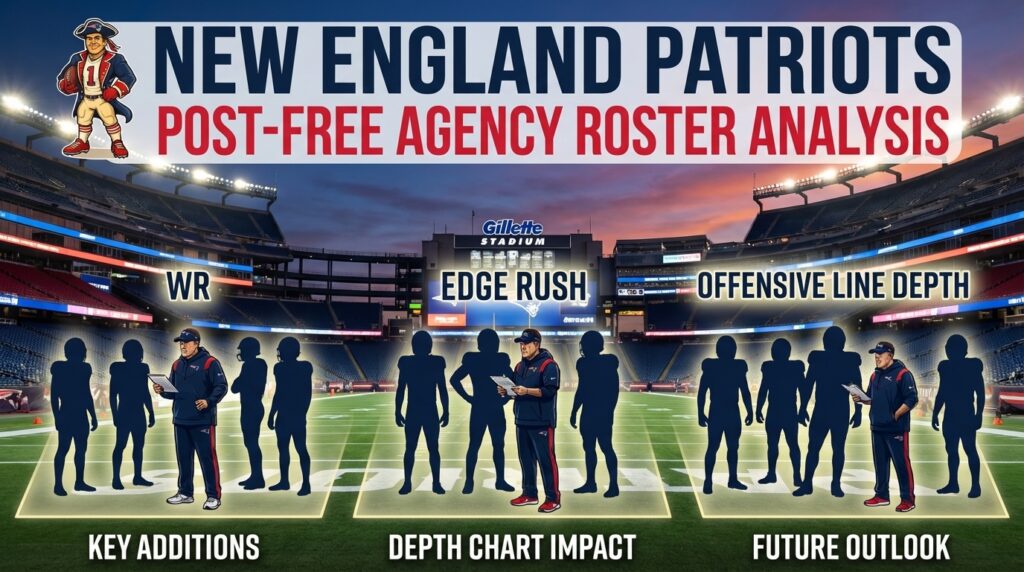
Patriots roster needs after free-agency spending spree
Patriots roster needs after free-agency spending spree are clearer than they were a month ago. New signings including Dre’Mont Jones and Kevin Byard address big holes. However, the roster still needs a top-tier edge rusher, pass game weapon, and tackle solution. Because salary moves changed the picture, the team must balance depth and upside.
We will examine the offense, defense, and draft strategies in detail. First, the receiver room looks improved, yet a true No. 1 remains a question. Second, pass rush production was thin last season, therefore adding pressure will stay a priority. Finally, the tackle situation demands long term answers because postseason play exposed weaknesses.
This piece takes an analytical, forward-looking view with cautious optimism. We will weigh free agency gains against remaining roster shortfalls and draft priorities. As a result, readers will get clear areas the Patriots must target in April. Expect analysis of targets like KC Concepcion and potential trade interest for A.J. Brown.
Patriots roster needs after free-agency spending spree: three priorities
The Patriots made notable additions in free agency, yet core gaps remain. Because New England totaled just 35.0 sacks across 17 games, pass rush ranks as the clearest deficit. However, the front office also faces questions at tackle and at a true No. 1 receiver. This section breaks down each need with facts, trade and draft options, and short-term versus long-term fixes.
1 Edge rush and consistent pressure
The Patriots need an edge rusher who can win one-on-one matchups. Last season the team produced 35.0 sacks, and only six teams finished worse. As a result, pressure on opposing quarterbacks was inconsistent. Dre’Mont Jones helps inside, and he had 7.5 sacks and 24 QB hits in 2025 (see player profile at Dre’Mont Jones). However, the Pats lack a dominant outside threat.
Key considerations
- Short term: pursue proven veterans or a midlevel trade to add speed and snap-to-snap play. For example, a veteran like Maxx Crosby would change the pass rush instantly, but would cost assets.
- Draft option: target top edge prospects such as Cashius Howell, Zion Young, or Akheem Mesidor with the 31st pick.
- Depth: add rotational pieces to avoid drop-offs when starters rest or get injured.
2 A clear No. 1 receiver and pass-catch playmaker
Despite free-agency moves and slot upgrades, the Patriots still lack a true alpha receiver. Because A.J. Brown has a proven 1,000-yard track record, he remains a trade target. The team could wait until after June 1 to explore a deal. Alternatively, New England could use the 2026 first-round pick to chase KC Concepcion, a college standout at Texas A&M.
Points to weigh
- Trade cost versus draft capital: a veteran No. 1 costs picks or players. Therefore the team must balance present needs with future assets.
- Scheme fit: consider how a physical receiver would pair with Drake Maye or the existing corps.
3 Tackle stability and offensive line longevity
The left tackle job carries playoff implications. Will Campbell projects as the starter in 2026, yet concerns remain because of his postseason pass protection. Meanwhile Morgan Moses turned 35 this month, and he offers short-term veteran help only. Consequently, the Patriots should seek a long-term solution.
Options and timeline
- Draft: Blake Miller emerges as a realistic first-round tackle target at pick 31.
- Free agency: pursue a mid-tier tackle to start while grooming a rookie.
- Development: evaluate internal options like Vederian Lowe and invest in coaching to improve pass sets.
Conclusion
The free-agency spending spree did improve personnel. However, edge rushing, a true No. 1 receiver, and tackle depth remain the three key priorities. Moving forward, the Patriots must balance draft capital, veteran trades, and development to convert optimism into consistent wins. For team stats and more context, refer to the Patriots 2025 team page.
| Player Name | Position | Age | Strengths | Potential Fit with the Patriots |
|---|---|---|---|---|
| KC Concepcion | Wide Receiver | ~21-22 | Size, contested catch ability, red zone threat | Can step in as a physical perimeter target; realistic first-round option at 31 |
| Cashius Howell | Edge Rusher | ~21-23 | Quickness, bend around the edge, high motor | Draftable pass rusher to boost sack opportunities; fits rotational and starter upside |
| Zion Young | Edge Rusher | ~21-23 | Power rush, run defense, length | Projects as a stout situational edge; adds two-down strength and interior push |
| Akheem Mesidor | Edge Rusher/OLB | ~21-23 | Versatility, athleticism, scheme flexibility | Immediate special teams and rotation piece with starter upside in competing scheme |
| A.J. Brown | Wide Receiver | 28-29 | Elite contested catches, yards after catch, proven consistency | Trade target for instant alpha receiver; high cost in picks or salary but solves No. 1 need |
Patriots roster needs after free-agency spending spree: defensive line and edge rush impact
The Patriots upgraded the defense in free agency, yet edge rushing remains a focal point. Dre’Mont Jones brings interior power and proven production. He recorded 7.5 sacks and 24 quarterback hits in 2025. As a result, Jones should anchor the front and free others to pressure the quarterback.
Kevin Byard adds veteran leadership in the secondary, and his presence helps the front seven. Because the Patriots finished with 35.0 sacks across 17 games, pressure remained inconsistent. Therefore the team still needs outside explosiveness to finish drives. A stronger edge group would convert more pressures into sacks and turnovers.
There’s a lot to like about what a physical player like Jones can offer on a Vrabel-led team. However, the roster lacks a dominant outside rusher. Consequently, New England must evaluate veteran trades and the draft. The front office could pursue an elite veteran, while also targeting rookie edge talent at 31.
Draft prospects to watch
- Cashius Howell: quick off the snap, natural bend, and high motor. He projects as a young speed rusher with starter upside.
- Zion Young: power driven, excels in run defense and two-gap work. He fits schemes that need stout edge force.
- Akheem Mesidor: versatile with size and athleticism. He offers immediate special teams value and rotational snaps.
Short term versus long term approach
- Short term: sign a veteran or pursue a trade to provide immediate splash plays. This reduces pressure on young starters early in the season.
- Long term: draft high-upside edge help and develop rookies behind Jones and other veterans. This balances cap concerns with sustainable pass rush growth.
In summary, the Patriots improved talent and depth. However, adding an outside game wrecker remains critical. We’ll explore anything that we think can help the team, and front-office decisions should reflect that urgency. As a result, combining veteran additions and draft investments gives the best path to consistent pressure and more victories.
Conclusion
Patriots roster needs after free-agency spending spree remain clear: edge rush, a true No. 1 receiver, and tackle stability. New signings like Dre’Mont Jones and Kevin Byard improved talent and leadership. However, key gaps persist despite the spending. This evaluation takes a measured, forward-looking view with cautious optimism.
Because New England managed only 35.0 sacks last season, pass rush urgency is obvious. Therefore, adding an outside game wrecker is the most pressing need. Draft prospects and veteran trades both offer solutions. Short-term veteran additions could buy time for rookies to develop. As a result, the front office must balance short-term wins with long-term roster health.
The receiver room improved, yet a proven alpha would change the offense. The tackle position needs a bridge or a long-term starter because postseason play exposed weaknesses. Expect near-term moves at the draft and via trades as April approaches. Patriots Report LLC will continue tracking these moves closely. Follow coverage at patriotsreport.com and on Twitter X via @ZachGatsby for updates. Ultimately, the right blend of veterans and prospects gives the Patriots the best path forward.
Frequently Asked Questions (FAQs)
What immediate impact did the free-agency spending spree have on the roster?
The Patriots added proven veterans and leadership in key spots. For example, Dre’Mont Jones strengthens the interior pass rush. Kevin Byard improves the secondary and helps communication. However, the additions do not fully erase all roster weaknesses.
Which roster gaps still rank as priorities after free agency?
Edge rushing remains urgent because New England recorded only 35.0 sacks in 17 games. Therefore, the team also needs a true No. 1 receiver and tackle stability. Short term fixes and draft investments should work together to close these gaps.
Will the Patriots pursue a veteran No. 1 receiver like A.J. Brown?
A.J. Brown is a clear upgrade and a realistic trade target. Yet a deal would cost significant picks or salary cap space. As a result, New England might wait until after June 1 before making a push.
What draft prospects should Pats fans watch with pick 31?
The team could target KC Concepcion at wide receiver. Additionally, top edge prospects include Cashius Howell, Zion Young, and Akheem Mesidor. Each offers different traits:
- Cashius Howell: speed and bend off the edge.
- Zion Young: power and run-defense chops.
- Akheem Mesidor: versatility and immediate special teams value.
How should the team balance veterans, trades, and draft picks?
Balance short-term and long-term needs by mixing veteran additions with rookies. Drafting edge or tackle help still matters. Meanwhile, a high-cost trade can solve one need quickly, but it may hurt future flexibility. Therefore, the front office must weigh immediate impact against sustainable depth.
If you want deeper analysis, check the rest of this piece on Patriots roster needs after free-agency spending spree for targets and timelines.