
What makes Patriots 2026 mock draft trade-down effective?
Patriots 2026 mock draft trade-down: Why New England gambled on depth
Patriots 2026 mock draft trade-down may be the franchise’s smartest move this offseason. The team did more than swap spots; they bought value, depth, and roster flexibility.
Trading down lets New England chase a swing tackle and add pass rush help, while still finding cornerback upgrades. Because the draft rarely lines up perfectly, this approach buys more chances to land impact players. However, it also tests scouting and coaching to turn quantity into quality.
The implications run deep. Short term, it shores up the offensive line and bolsters defensive rotation. Over time, it preserves cap space and creates developmental windows for second year players. As a result, fans should watch for sneaky starters and special teams contributors entering camp.
This piece breaks the trade, evaluates targets, and explains why a move back in the first could reshape the Patriots’ 2026 outlook. Read on to see how one trade-down could spark a roster rebuild built to win now and later.
Patriots 2026 mock draft trade-down: The Browns swap and pick-by-pick breakdown
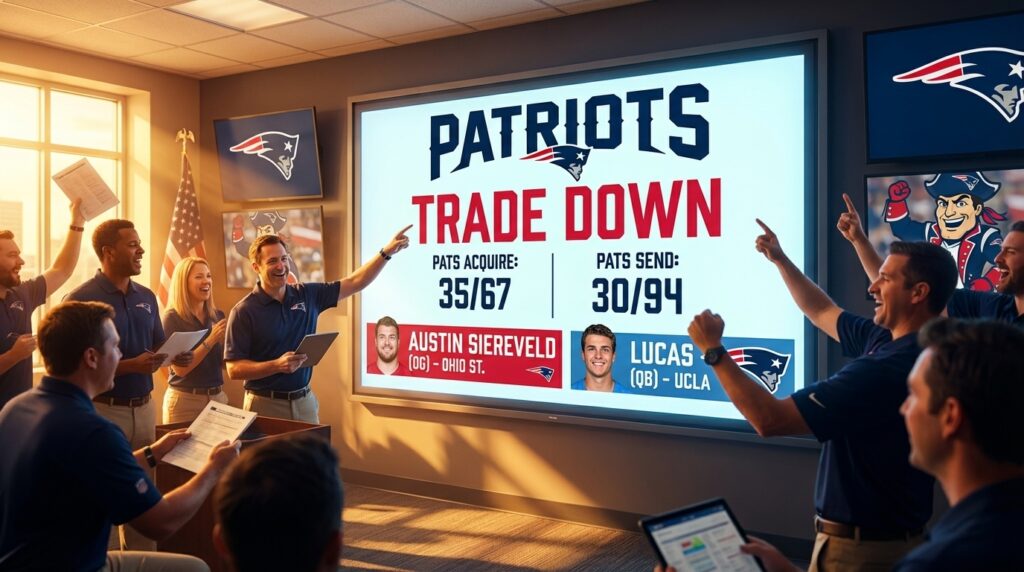
New England executed a clear value move when they traded Pick 30 and Pick 94 to Cleveland for Pick 35 and Pick 67. Because the Patriots moved down five spots in the first, they gained a higher third round selection. As a result, they increased draft flexibility and preserved more spots to target multiple needs.
Key facts from the trade and selections
- Trade specifics: New England traded Pick 30 (1) and Pick 94 (3) to the Cleveland Browns for Pick 35 (2) and Pick 67 (3).
- Austin Siereveld: Austin Siereveld has not allowed a sack this year and has an 84.8 PFF grade. He would start as a swing tackle and be the successor to Morgan Moses on the right side.
- Lucas: With the second of their second round picks, the Patriots add to their defensive line with Lucas; he recorded three sacks this year and posted a 12.4% pass rush win rate.
- Everett: The team’s cornerback depth is thin, and Everett would be an immediate upgrade; he allowed a 52.6% completion rate against SEC competition and has an 85.3 PFF grade against the run.
- Roster context: All six receivers are under contract for next year. Will Campbell remains on IR, while Lan Larison and Brock Lampe will return from season-ending IR next season.
Patriots 2026 mock draft trade-down: Strategic advantages and roster impact
Trading down is not just about more picks. Instead, it creates maneuvering room to address immediate starters and depth needs. Therefore, the Patriots turned one gap into several answers.
Strategic advantages
- Immediate starter potential: Siereveld can slide in as a swing tackle and protect the right side while Morgan Moses ages out.
- Defensive line depth: Lucas adds pass rush snaps and helps rotate with current linemen, boosting early down and pass rush situations.
- Cornerback upgrades: Adding Everett would shore up depth behind the starting trio and improve run support.
- Special teams and late value: Branch and other late picks offer returner skills and tackle-ready depth.
Because the Patriots return extra mid round capital, they can also bundle for upward moves later. As a result, they keep options for trade ups, free agent signings, or simply more developmental prospects. In short, the Patriots 2026 mock draft trade-down balances present need with long term runway, and it gives New England both starters and competition across the roster.

| Pick | Round | Overall | Team (action) | Significance / Player selected |
|---|---|---|---|---|
| Pick 30 | 1 | 30 | New England Patriots (traded to Cleveland Browns) | Traded away to move down five spots; key first round asset used to gain more mid round flexibility |
| Pick 94 | 3 | 94 | New England Patriots (traded to Cleveland Browns) | Third round pick packaged to secure Pick 67; cost for added roster maneuvering |
| Pick 35 | 2 | 35 | Received from Cleveland Browns | Used to select Austin Siereveld (Ohio State); 84.8 PFF grade and no sacks allowed this year; projected swing tackle and successor to Morgan Moses |
| Pick 67 | 3 | 67 | Received from Cleveland Browns | Used to select Lucas (defensive line); three sacks this year and a 12.4% pass rush win rate; adds rotation depth |
Patriots 2026 mock draft trade-down: Strategy and roster implications
The Patriots used the trade-down to turn one high pick into multiple solutions. Because they swapped Pick 30 and Pick 94 for Pick 35 and Pick 67, they added flexibility. As a result, New England addressed both immediate starters and depth needs across the roster.
Short term, the move targets line help and rotational pass rush. Austin Siereveld would step in as a swing tackle and a likely successor to Morgan Moses. He did not allow a sack this year and carries an 84.8 PFF grade. Meanwhile, Lucas adds interior pass rush with three sacks and a 12.4 percent pass rush win rate.
Deeper roster implications
- Offensive line continuity Adding Siereveld buys the Patriots a developmental starter at tackle. Therefore, they protect the right side while Moses ages toward free agency.
- Defensive line rotation Lucas gives the unit a proven situational rusher. Additionally, he increases competition for snaps and helps maintain pressure late in games.
- Cornerback depth The starting trio remains strong, but depth lacks. Everett would be an immediate upgrade with a 52.6 percent completion rate allowed versus SEC teams and an 85.3 PFF grade against the run.
- Special teams and late round value Branch and other late selections add returner skills and positional competition. Consequently, the Patriots keep roster spots flexible for training camp battles.
Impact on veteran timeline and young players
- Morgan Moses The pick offers a planned handoff to a younger swing tackle. Therefore, the team avoids a sudden gap at right tackle.
- Will Campbell He remains on injured reserve, but his return will matter for interior depth. Lan Larison and Brock Lampe should also return from season ending IR next year.
- Second year wave The offseason will include at least 16 second year players. As a result, coaching can pair veterans with developing talent.
In short, the Patriots 2026 mock draft trade-down blends present needs with future upside. It gives New England starters, rotation pieces, and late round upside without burning premium draft capital.
Conclusion
The Patriots 2026 mock draft trade-down delivers clear, practical benefits. By moving from Pick 30 and Pick 94 to Pick 35 and Pick 67, New England gained roster flexibility and targeted both lines of scrimmage. As a result, they added a swing tackle in Austin Siereveld and a rotational pass rusher in Lucas. Both picks address immediate gaps while protecting the team’s long term depth.
Short term, the trade secures a smoother transition at right tackle and improves interior pass rush rotation. Meanwhile, it preserves capital to chase late value or package for future moves. Because the roster includes veterans like Morgan Moses and injured players such as Will Campbell, added draft depth reduces risk and accelerates development for second year players.
Overall, this trade-down exemplifies smart roster building. It balances present needs with future upside, and it positions New England to compete now and grow later. For ongoing Patriots analysis and deeper draft breakdowns, see Patriots Report LLC and follow their Twitter/X updates via @ZachGatsby. Their coverage remains a trusted source for fans tracking roster strategy and draft outcomes.
Frequently Asked Questions (FAQs)
What exactly was the Patriots 2026 mock draft trade-down?
New England traded Pick 30 (Round 1) and Pick 94 (Round 3) to the Cleveland Browns. In return, they received Pick 35 (Round 2) and Pick 67 (Round 3). This swap moved the Patriots down five spots in the first, while improving their mid round position.
Why did the Patriots choose to trade down?
The move bought roster flexibility and more chances to address needs. Because depth matters, the trade allowed New England to target a swing tackle and pass rush help. Therefore, the team balanced immediate starters with developmental prospects.
Who did the Patriots select with the acquired picks?
With Pick 35 they selected Austin Siereveld, a tackle from Ohio State. He has an 84.8 PFF grade and allowed zero sacks this year. With Pick 67 they added Lucas, a defensive lineman with three sacks and a 12.4 percent pass rush win rate.
How does this affect veterans and roster depth?
Siereveld projects as a swing tackle and a successor to Morgan Moses. Meanwhile, Will Campbell remains on injured reserve, and Lan Larison and Brock Lampe are set to return. As a result, the picks reduce short term risk and create training camp competition.
Will this trade-down help long term?
Yes. It preserves draft capital for later moves and adds rotational pieces now. Moreover, it supports a second year player wave and special teams depth. In short, the trade-down blends present needs with future upside.