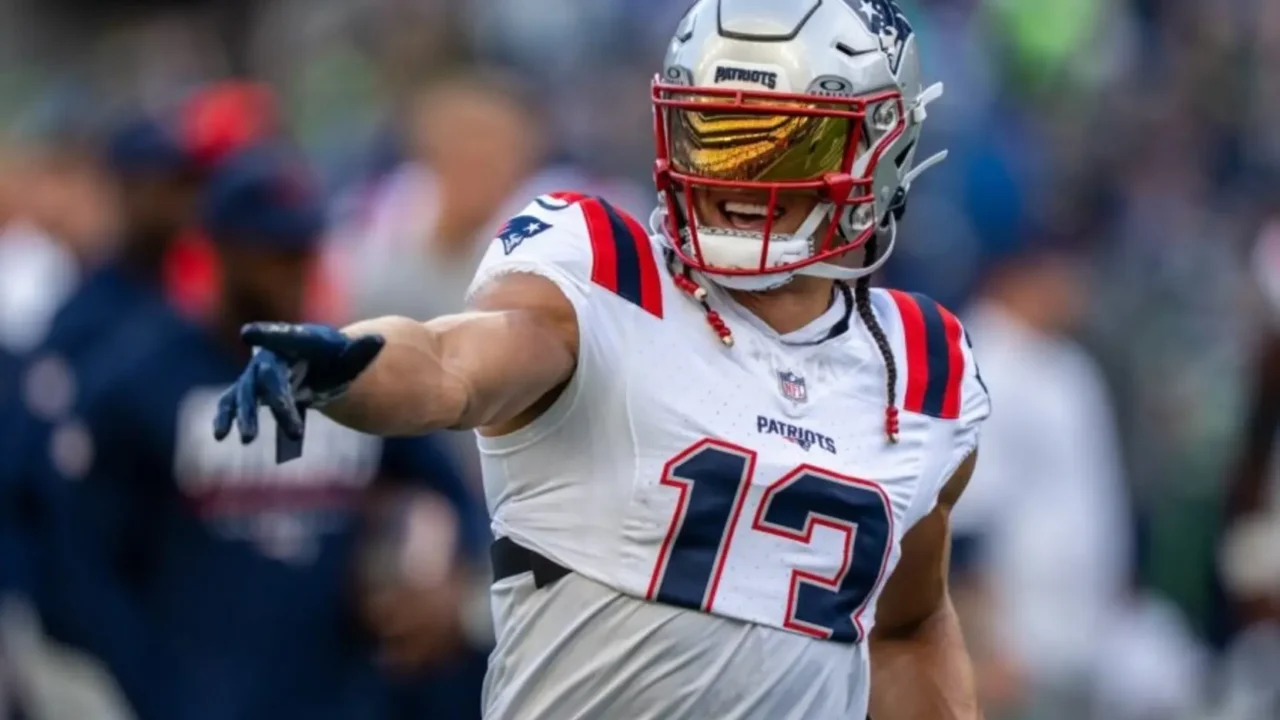
Mack Hollins contract renegotiation headlines a targeted roster move for the New England Patriots after Spotrac reported adjusted reception bonuses ahead of the 2026 season. Speaking at Gillette Stadium, Hollins acknowledged the changes and framed the rework as a business decision; the announcement comes with A.J. Brown sidelined for at least a month with a high ankle sprain, temporarily increasing the value of available pass-catchers on the roster.
Contract detail attribution: the threshold changes were first detailed by Spotrac (reporter Michael Ginnitti) and covered locally by Boston.com. PatriotsReport summarizes the adjustments, Hollins’ comments, and the near-term roster and cap implications below.
Quick facts
- $300,000: reception bonus threshold changed from 30 → 47
- $300,000: reception bonus threshold changed from 40 → 50
- $400,000: reception bonus threshold changed from 50 → 55
- Last season: 46 catches (550 yards, 2 TDs)
Contract detail attribution: Spotrac / Michael Ginnitti.
What changed in Mack Hollins contract renegotiation
The headline of the Mack Hollins contract renegotiation is straightforward: the Patriots increased Hollins’ reception thresholds for three performance bonuses that together could have paid him up to $1,000,000 in 2026. Per Spotrac’s report, the structured changes are summarized in the table below.
Spotrac’s breakdown (Michael Ginnitti) is the primary public source for the exact threshold numbers. By moving the first payout from 30 to 47 catches, the Patriots have made the initial bonus significantly harder to reach; the following tiers also demand material increases in production. That design reduces the chance of bonuses paying out without a corresponding increase in offensive opportunity.
Hollins at Gillette Stadium
At a media session at Gillette Stadium, Mack Hollins discussed the renegotiation and framed it as part of the business realities players face. He offered several lines that capture his viewpoint and approach to the new incentives.
On whether the adjustments provide extra motivation: “Yeah, I’d say it does. Makes you wanna come out and work, but not any harder than I already work. That’s an unfortunate side of the business, but I’m happy to be here.”
When asked about being open to contract tweaks: “I wouldn’t say, like, nobody wants to change anything. But that’s sometimes what happens.”
On the negotiation dynamic and his understanding of the team’s options: “That’s kind of how it works. That’s the risk that you run. It’s like, ‘Hey, you could take this offer, or we could potentially cut you.’ They’re not saying, like — that’s the business. So, it could go either way. Like, I’m happy to be here. My goal is to go hit all those incentives. It doesn’t matter whatever you put them at. I’m gonna go try to hit them, and it’ll be water under the bridge.”
Those lines reflect Hollins’ characterization of the negotiation and include his phrasing that the team “could potentially cut” him; Patriots officials have not publicly framed the talks as an ultimatum. Presenting Hollins’ comments as his perspective maintains the distinction between player remarks and organizational fact.
Roster and cap impact
Multiple reports note that releasing Hollins before the regular season would have yielded roughly $3.8 million in immediate cap savings. Accepting tougher thresholds instead preserves depth while limiting the chance of guaranteed payouts. This tradeoff is especially relevant after the Patriots trimmed receiver depth by trading Kayshon Boutte earlier this offseason.
With A.J. Brown expected to miss at least a month, the Patriots’ short-term need for pass-catchers increases. That context likely encouraged both sides to find a compromise: the team maintains flexibility and avoids an immediate $3.8M roster adjustment, while Hollins keeps a roster spot and the chance to earn incentives through performance.
From a cap-management perspective, incentive reworks are a common tool to reduce near-term cash outlays or roster churn without creating larger guaranteed liabilities. The updated thresholds in Hollins’ deal push meaningful payout probability toward seasons in which he receives more consistent targets and snaps.
What this means for targets and playing time
Hollins finished 2025 with 46 catches, placing him just below the first updated threshold. He has topped 50 catches only once in his career, so the new structure effectively asks for a near-career-best season for the larger bonuses to arrive.
Practically, Hollins should see a modest uptick in opportunity while Brown recovers; however, any projection that Hollins will become a primary target for Drake Maye goes beyond the available evidence and should be treated as speculative. For additional context on quarterback contract dynamics and team planning, see our drake maye contract coverage linked below.
Realistic near-term metrics to evaluate Hollins’ chances of reaching those incentives include snap share, route participation (slot vs. boundary), target share, and red-zone usage. An increase across those categories would be necessary for the 47/50/55 thresholds to become attainable.
What to watch next
- Daily practice reports and official injury updates on A.J. Brown — his availability will determine short-term target distribution.
- Hollins’ early-season snap counts and alignment; consistent playing time is a prerequisite for hitting the higher thresholds.
- Weekly target share and routes run statistics; incremental gains week to week are measurable signs the incentives could pay out.
- Official Patriots statements on roster construction or future cap planning that mention receivers or incentive design.
Those are the objective signals media and fans can track to see whether the renegotiation materially changes Hollins’ season or remains a contingency that never fully pays out.
Key takeaways
- The Patriots raised Hollins’ reception thresholds across three bonuses, making payouts harder to reach.
- Hollins emphasized the business nature of the talks and said he was happy to remain with the team.
- Cutting Hollins would have saved roughly $3.8M in cap space, but reworking the deal preserved depth while lowering payout probability.
Source attribution: This story relies on reporting from Boston.com (Conor Ryan) and contract-detail coverage credited to Spotrac reporter Michael Ginnitti. Hollins’ quotes were gathered at a Gillette Stadium media availability and are presented here as his characterization of the negotiations. For full original reporting and the Spotrac breakdown, consult those pieces.