Drake Maye drew pointed scrutiny from former New England standouts after the Patriots’ 20-3 home win over the Pittsburgh Steelers. Boston.com reporter Khari A. Thompson summarized comments from Rob Gronkowski and Julian Edelman on Sept. 22, 2026; this story links those former-player observations to verifiable game facts and outlines what to watch next.
Source: Boston.com — Khari A. Thompson, Sept. 22, 2026
Lede — Boston.com: Concerns About Drake Maye After 20-3 Win
On the latest episode of the “Gronk and Jules” show, former Patriots Rob Gronkowski and Julian Edelman asked whether fans should be worried about Drake Maye, even after New England’s 20-3 victory at Gillette Stadium. Khari A. Thompson’s Boston.com summary frames the conversation as former-player opinion focused on Maye’s comfort and mechanics under pressure.
Quick box-score recap and key facts
Here are the measurable facts that provide the foundation for the critique: through two games the Patriots offense is averaging 15 points per game, down from 28.8 PPG in last season’s regular slate. Drake Maye has thrown 1 TD and 4 INTs through two games and has been sacked 6 times. In the 20-3 win over Pittsburgh, Romeo Doubs compiled a career-high 96 receiving yards. Those outcomes are verifiable and form the factual baseline for the later commentary.
What Gronkowski and Edelman actually said (sourced quotes)
These are opinions from former players, reported by Boston.com. According to the story, Edelman asked, “Are we worried about Drake Maye, the Patriots, and the offense?” Gronkowski replied, “I’m worried,” and suggested Maye was “regressing a little bit” compared with stretches from last season. Boston.com quotes Edelman directly: “Drake didn’t look comfortable at all. He looks — even on that interception, his feet aren’t set. He’s like drifting. He just doesn’t feel comfortable.”
Labeling: these lines are reported as the personal views of Gronkowski and Edelman, not as evaluations from Patriots coaches, staff, or medical personnel.
Tape-backed analysis — mechanics, pressure, and decision-making
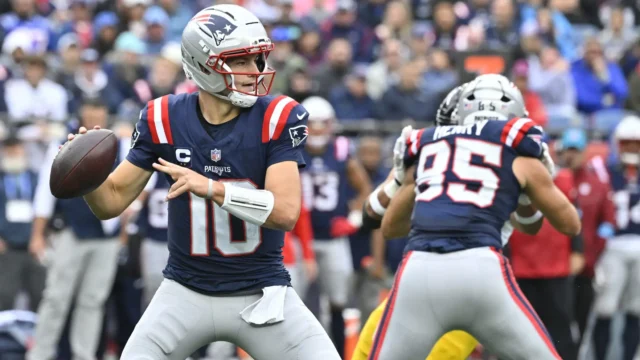
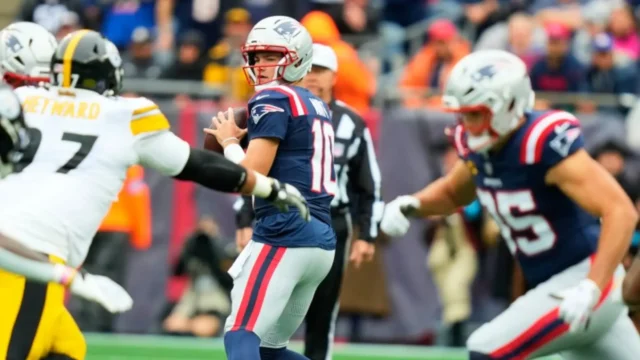
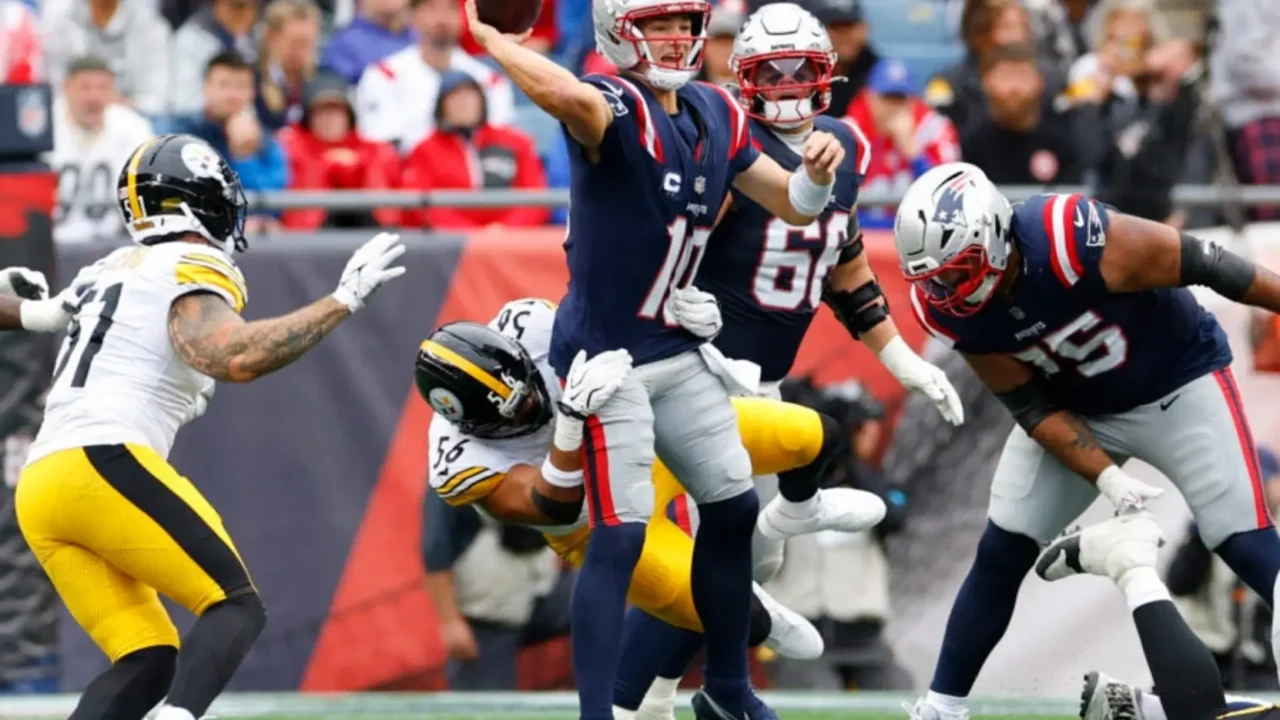
Linking the commentary to tape and box-score facts helps separate opinion from measurable outcomes. Maye’s four interceptions and six sacks over two games are objective markers that make the former players’ concerns plausible. Boston.com included a photo noting Maye throwing under pressure from Alex Highsmith during the third quarter at Gillette Stadium; repeated pressure events can expose or exacerbate footwork and rhythm issues.
Film areas to evaluate (based on the reported commentary and box-score evidence):
- Pre-throw foot placement and balance: Does Maye re-set his feet consistently before delivering throws when pressured?
- Pocket movement versus getting outside: Does he climb and re-set within the pocket or does pressure force hurried decisions?
- Progression discipline: Are interceptions the result of missed reads, telegraphed throws, or receiver separation issues?
Measured outputs (sacks, INTs) show consequences but not complete causation; a pressured quarterback can still perform if protections, quick game design and receiver separation compensate. The photo and the sack/INT totals cited by Boston.com point to pressure as a contributing factor that merits closer film study, not a definitive cause on its own.
Offense supporting context — injuries and other contributors
Context matters when interpreting individual performance. Per Boston.com, A.J. Brown left the season opener with a high-ankle sprain and remains out, limiting Maye’s top-target options and changing defensive game plans. Romeo Doubs stepping up for a 96-yard game is a positive sign, but the offense also saw Rhamondre Stevenson lose a fumble and face a brief benching, a sequence that reduced early down confidence and play-calling balance.
In short: receiver availability, running-game reliability and protection design all influence a young quarterback’s stat line. Those factors help explain why former players pointed to comfort and processing rather than isolating the quarterback as the sole issue.
What this means (and what remains uncertain)
Reasonable takeaways: informed former-player opinions underscore plausible points — mechanical issues under duress, early-season turnover risk, and the effect of missing key targets like A.J. Brown. Those observations gain traction because they align with measurable problems (interceptions and sacks).
What remains uncertain: whether the pattern is temporary (fixable via game plan adjustments, protection schemes and Brown’s return) or an emerging trend. Two games constitute a small sample; opponent pass-rush tactics, specific play calls and single-game variance all influence these early numbers. Gronkowski and Edelman’s views are useful as experienced perspectives but are not the same as a coach’s grading or a technical film-study report from the Patriots staff.
What to watch next
The next two to three games will provide clearer signals. Concrete metrics to track:
- Sacks taken per dropback (pressure rate) — a falling rate suggests protection and game-plan fixes.
- Interception rate — fewer turnovers would undercut claims of systemic processing problems.
- Third-down conversion and points-per-drive — improvement would point to better situational execution even if raw yardage lags.
Also watch the status and usage of A.J. Brown and whether the Patriots adjust with quicker passing concepts or additional help in the pocket. Improvement in these areas would reduce the force of former-player critique; continued struggles would increase scrutiny.
By-the-numbers: Maye and Patriots through two games
Notes: team PPG of 28.8 cited as last season’s regular-season average; A.J. Brown remains out with a high-ankle sprain per Boston.com reporting.
Source attribution
This report is grounded in Boston.com’s coverage: Khari A. Thompson, “Rob Gronkowski and Julian Edelman explain why they’re worried about Drake Maye,” published Sept. 22, 2026. Original reporting: Boston.com. The Gronkowski and Edelman lines are presented as former-player opinion and not as official evaluations from current Patriots staff.
What to watch next: track sack rate, interception frequency, and A.J. Brown’s availability across the coming two to three games for clearer evidence of trend or noise.