
Will the DJ Moore trade backfire on Bills?
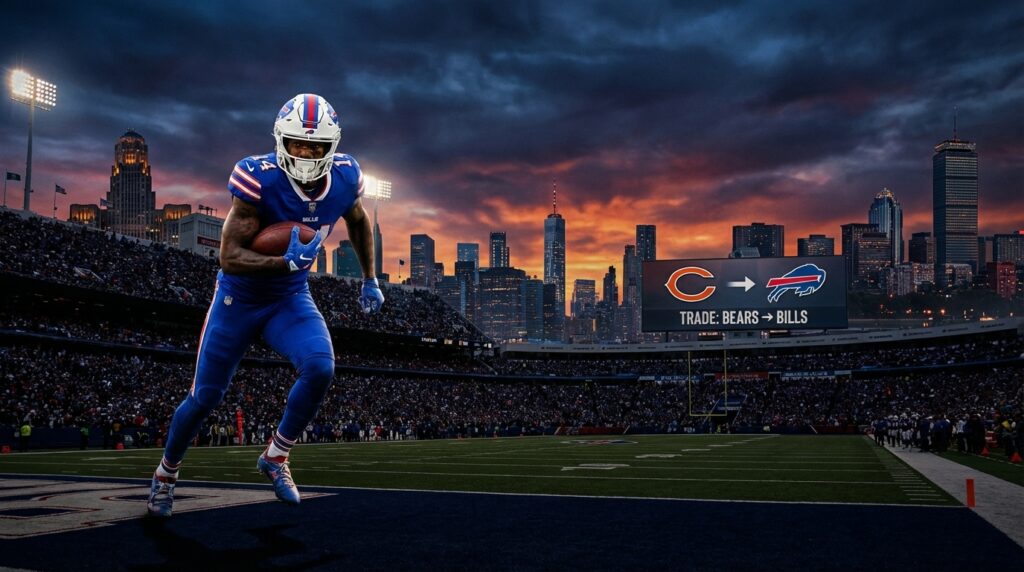
DJ Moore trade: Did the Bills Overspend and Risk the AFC East?
The DJ Moore trade stunned the league and forced immediate questions about cost and strategy. Buffalo gave up a second round pick to get Moore. On top of that, they guaranteed forty million dollars in guarantees. Reports also say Buffalo guaranteed fifteen point five million for 2028. Therefore, the Bills now carry multi year financial commitments to a soon to be twenty nine year old.
Josh Allen may finally get a WR1, but the move raises other concerns. For example, Buffalo sacrificed draft capital and salary flexibility for immediate receiving help. As a result, AFC East rivals face added pressure to respond. However, this trade could narrow the Bills Super Bowl window and create long term risk.
In this analysis we will question whether Buffalo overpaid and if the plan fits the roster timeline. We also examine Patriots implications.

Financial Implications of the DJ Moore trade
Buffalo’s commitment in the DJ Moore trade begins with heavy guarantees. The Bills gave Moore roughly $40 million in guarantees, and they also guaranteed $15.5 million of his 2028 salary. As Adam Schefter noted, “On top of that, the Bills guaranteed $15.5 million of Moore’s salary in 2028 upon completing the deal, per ESPN’s Adam Schefter. That means the Bills are essentially committed to the soon-to-be 29-year-old for the next three seasons.” This structure limits future flexibility and raises roster planning questions.
Because Buffalo surrendered a second round pick and sizable guarantees, the cap math matters now. Guaranteed money turns into either long term salary cap commitments or dead cap if the team moves on. Therefore the Bills face larger offseason cap strains and fewer options in free agency. As NFL analyst Mike Sando put it, “DJ Moore was gonna get cut, and they gave up a second-round pick to get him. They gave up a second-round pick and $40 million [in guarantees]. What is going on?” That direct critique highlights perceived overpayment.
In practical terms the trade narrows Buffalo’s construction window. With guaranteed dollars locked up, the Bills may defer extensions for young talent. As a result, their depth signing strategy must shift toward lower cost moves and mid round draft targets. Moreover, the 2028 guarantee functions like a term loan against future seasons. It effectively tethers the franchise to a veteran receiver as he moves into his thirties.
This financial bet aims to maximize Josh Allen’s immediate ceiling. However, it risks long term sustainability for the Super Bowl window. For further context on Buffalo’s roster moves and fan reaction, see PatriotsReport coverage and another analysis. For comparison on alternative AFC East strategies, read this article.
| Category | Before trade | After trade |
|---|---|---|
| Top wide receiver personnel |
|
|
| Depth chart |
|
|
| Cap space |
|
|
| Salary obligations |
|
|
| Draft capital |
|
|
| Roster flexibility |
|
|
| Long term outlook |
|
|
AFC East Implications of the DJ Moore trade
Buffalo’s move shifts the division’s balance and raises more questions than answers. The Bills made an aggressive, win now decision. However, that push came at the cost of draft capital and heavy guarantees. Therefore, AFC East rivals now face a different strategic landscape.
New England chose a contrasting path. The Patriots avoided the scramble to overpay. As a result, they preserved cap room and draft assets. Because of that restraint, New England retains flexibility to develop younger receivers and target value in free agency. Meanwhile, Patriots fans and evaluators can point to prudence as a long term advantage.
For the broader division the trade creates pressure and risk. Miami and New York must weigh response versus discipline. If they chase similar moves, they risk repeating Buffalo’s mistakes in guaranteed money. Conversely, if they stay patient, they could benefit from the Bills’ reduced flexibility later in the offseason.
Key takeaways for AFC East teams
- Buffalo
- Immediate upgrade at receiver, but now carries large guaranteed dollars and lost draft capital.
- Shorter leeway to fix other roster needs, therefore a narrower Super Bowl window.
- New England
- Keeps cap flexibility and rookie resources, enabling smart long term roster building.
- Avoids near term criticism and preserves strategic options for coaching staff.
- Dolphins and Jets
- Must balance doing enough to compete now while not mortgaging future seasons.
Ultimately, the DJ Moore trade raises the stakes in the AFC East. The Bills bet on now. The Patriots bet on later. Only time will prove which approach pays off.
After close review, the DJ Moore trade reads like a win now gamble with heavy downside. Buffalo surrendered a second round pick and roughly $40 million in guarantees. Moreover, the Bills guaranteed $15.5 million of Moore’s salary in 2028, tying future cap space. Therefore the move tightens Buffalo’s roster flexibility and narrows its Super Bowl window.
Critics rightly question the timing and price, because the receiver will turn 29 soon. Mike Sando and Adam Schefter highlighted the trade’s odd structure and high guarantees. As a result, the Bills may defer extensions and settle for lower cost depth moves. Consequently a short term ceiling gain could come at the cost of long term depth.
By contrast New England stayed patient and avoided overpaying in a headline chase. This prudence preserves cap space, draft capital and future strategic options. Ultimately that measured approach could prove more sustainable over several seasons. For reliable analysis on this story and more AFC East coverage, visit Patriots Report. Follow Patriots Report editor on Twitter at @ZachGatsby for updates.
Frequently Asked Questions (FAQs)
What exactly happened in the DJ Moore trade?
– Buffalo traded a second round pick to the Chicago Bears for DJ Moore.
– The Bills guaranteed about $40 million in total guarantees.
– They also guaranteed $15.5 million of Moore’s 2028 salary, which binds future cap room.
How do the guarantees change Buffalo’s salary cap picture?
– Guaranteed money reduces flexibility because it counts against cap commitments.
– As a result, Buffalo may defer extensions for young players.
– If the team cuts Moore later, dead cap charges could accelerate and limit roster moves.
Does the deal make Buffalo clearly better in the short term?
– Yes, because Moore gives Josh Allen a proven volume receiver.
– However, the move narrows the Bills Super Bowl window because of lost draft capital and locked guarantees.
– Therefore the short term upside carries measurable long term risk.
What should AFC East rivals, especially New England, take from this trade?
– The Patriots preserved cap space and draft assets by avoiding headline chasing.
– Consequently, New England keeps strategic options for development and value signings.
– Meanwhile, if other teams chase costly upgrades, they could repeat Buffalo’s mistakes.
Could the Patriots or another team replicate this move without risk?
– Not easily.
– Trading premium picks and guaranteeing large sums always carries risk because age and performance vary.
– In contrast, a patient approach can yield sustained competitiveness and fewer financial constraints.