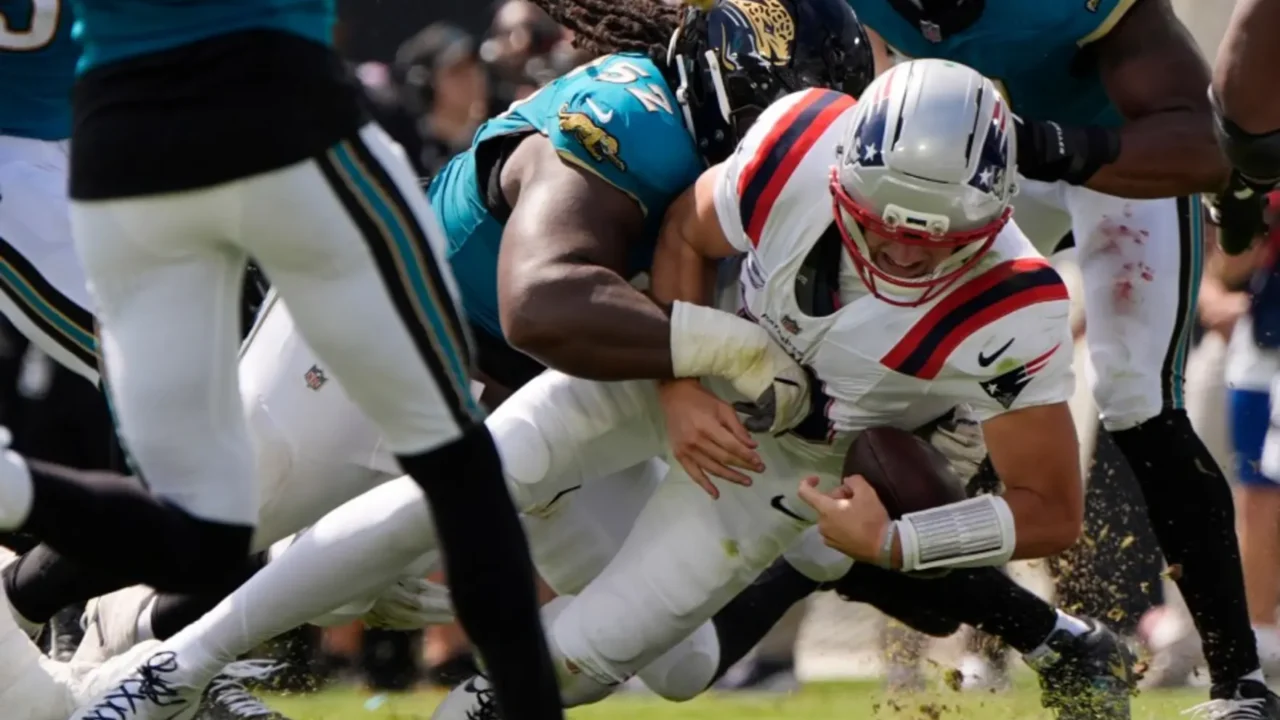
Drake Maye was at the center of a difficult night for the New England Patriots as, per WPRI, New England fell 35-6 in Jacksonville. The WPRI piece (published 2026-09-28T19:41:40.000Z) frames the outing as a meaningful step back and directly compares it to Maye’s fourth-quarter problems in Seattle.
Why Drake Maye struggled in Jacksonville
The WPRI analysis emphasizes observable, tape-driven issues rather than introducing new box-score claims. Across multiple drives, timing and anticipation appeared inconsistent; progressions seemed hurried on a number of throws and several planned rhythm concepts failed to develop into clean completions. Those are the kinds of execution lapses the WPRI author highlights when describing the game as a broader breakdown instead of an isolated late-game collapse.
On tape-level review, problems of this nature typically show as late throws, missed intermediate windows and difficulty climbing the progression tree when primary reads are covered. WPRI’s framing focuses on those visible tendencies: stretches where the offense lacked consistent cadence, and where Maye’s decision-making carried more variance than in earlier outings. Importantly, the piece avoids inventing specific statistics and keeps the critique at the level of pattern recognition and situational reads.
How Drake Maye’s Jacksonville game compared to the Seattle fourth-quarter debacle
WPRI directly compares this Jacksonville game to the Seattle fourth-quarter collapse, but with a clear qualification: Seattle was characterized by an extreme, concentrated late-game unraveling, while Jacksonville is presented as a more pervasive dysfunction across the contest. That distinction guides the article’s conclusion that this outing felt worse.
Put another way, the Seattle episode looked like an acute failure in a single phase of a game; WPRI’s read is that Jacksonville contained repeated execution problems that surfaced early and often. The difference matters from a trend perspective—isolated meltdowns can be corrected differently than systemic timing or processing issues. WPRI frames this as an evaluative judgment and the Patriots Report analysis maintains that cautious posture rather than treating either game as definitive proof of a long-term trajectory.
Coaching and schematic context around the performance
Any tape-level diagnosis benefits from situating a performance inside its schematic and coaching context. Patriots head coach Mike Vrabel and the offensive staff must balance correction with continuity: tightening pre-snap identification and simplifying progressions are common short-term fixes, while larger schematic adjustments carry roster and identity implications.
WPRI does not assign definitive blame to play-calling, and this analysis follows that restraint. The interaction between protection, route timing and quarterback processing can magnify mistakes; if pocket integrity or receiver separation is inconsistent, even routine constructs become harder to execute. What the WPRI piece—and a conservative tape read—both encourage is watching for subtle schematic nudges (more quick-game looks, clearer progression structure) rather than assuming an overhaul of offensive philosophy.
Short-term watchlist: measurable items to track
Heading into the next games, focus on verifiable, film-based metrics and situational reads. WPRI’s assessment suggests the following watchpoints that can be checked without relying on invented numbers:
- Timing on quick-developing throws: are windows opening earlier and are pre-snap reads cleaner?
- Progression discipline: does Maye consistently work through reads or do checks stop early?
- Third-down execution: are play-to-play decisions improving in high-leverage moments?
- Pocket management and protection clarity: is Maye getting steadier time and a clearer pocket on early downs?
- Play design adjustments: is the staff leaning into simplified reads or scheming to create higher-percentage completions?
Each item can be verified by film or situational box-score splits; these checks help separate transient noise from durable trends.
Cautious prognosis
WPRI’s language frames its judgment as evaluative rather than conclusive, and that is a prudent posture here. One full-game failure—albeit a significant one—constitutes a red flag that warrants follow-up, not an automatic season-long verdict. The Patriots’ coaching context and Maye’s developmental profile mean outcomes remain uncertain: the situation could improve quickly with schematic tweaks and execution corrections, or it could require longer-term structural adjustments if patterns persist.
For now, the proper approach is measured monitoring. Treat Jacksonville as a warning sign that raises the stakes on the next few games; let upcoming tape and situational performance provide the data needed to separate a bounce-back from the start of a trend.
Source attribution
This analysis is grounded in the WPRI story “Drake Maye’s slump goes from bad to worse for Patriots with a 35-6 drubbing in Jacksonville,” published 2026-09-28T19:41:40.000Z. Read the original WPRI piece here: https://www.wpri.com/sports/patriots-new-england-nation/drake-mayes-slump-goes-from-bad-to-worse-for-patriots-with-a-35-6-drubbing-in-jacksonville/.
What to watch next
In short: monitor whether timing and progression reads normalize, whether third-down decision-making improves, and whether coaching adjustments result in more consistent quick-game deployments. Those checks will be the clearest early signals that the Jacksonville game was an outlier rather than a persistent problem.