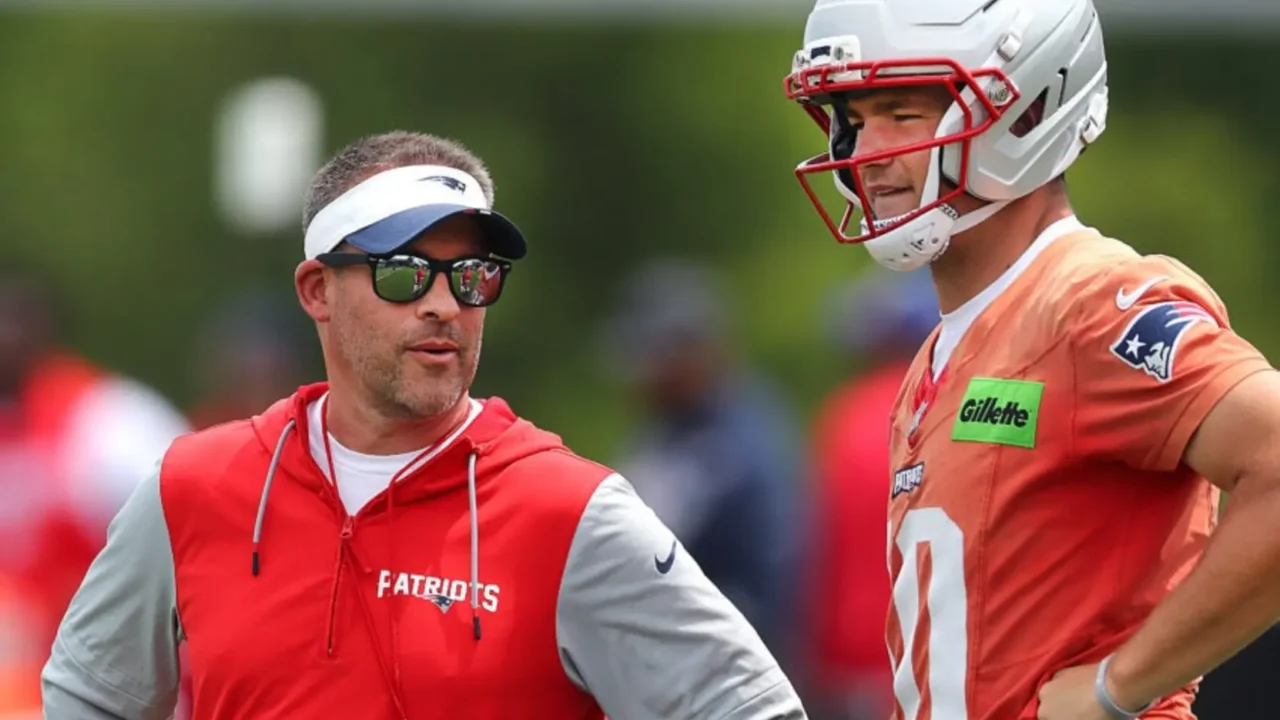
Drake Maye has been the focus of a debate this week: have opposing defenses adjusted enough that his recent struggles are more than a temporary slump? Patriots offensive coordinator Josh McDaniels answered that question Thursday at Gillette Stadium, saying the fix is largely internal. “It will require us to be — I would say, in my words — disciplined. Because patience sounds like a passive word to me,” McDaniels said.
Source: reporting from Boston.com (Conor Ryan, Sept. 17, 2026).
What McDaniels actually said
McDaniels framed the conversation as part coach assessment and part reminder to his offense. He acknowledged that more available tape on Maye invites opponent adjustments, but he stopped short of the phrase that “Maye is solved.”
Short excerpts McDaniels used: “I would say there was no film on him and our offense prior to Week 1 last year,” and “I think there’s a natural progression … when you have a year like Drake did last year, there’s going to be a reaction and a response to that.”
He returned repeatedly to the idea of balance: “You want to be aggressive when you get your chances … And then you’ve got to be smart with the football, because we know what our record has been when we don’t turn it over.” That last line ties his message to measurable outcomes rather than a scouting verdict.
Maye’s recent numbers (last five games)
Boston.com’s snapshot of Maye’s last five games (postseason included) is the statistical core of this discussion. The totals show both volume and turnover frequency that have driven the coach’s emphasis on discipline.
Table source: Boston.com (Conor Ryan, Sept. 17, 2026).
Why discipline and turnover margin matter for the Patriots
McDaniels tied his message to a clear team-level fact: New England is 10-0 since the start of 2025 when it wins the turnover battle. That correlation underpins the coaching priority to protect the ball.
Discipline, in this case, means situational decisions that reduce unnecessary risk while preserving the quarterback’s ability to create big plays. In practice that can include clearer pre-snap reads, quicker throws, better protection calls, and situational conservatism on deep shots.
It also connects to how the Patriots might use their complementary pieces. A heavier emphasis on the run and short-area completions — including work for backs like Rhamondre Stevenson and high-percentage target sequences — can shrink the number of high-variance plays Maye must force. That approach is a strategic lever; whether the Patriots use it consistently will be visible on Sunday.
How the Steelers matchup and A.J. Brown’s status change the plan
The Week 2 home game against the Pittsburgh Steelers changes some variables. With top receiver A.J. Brown unavailable, the Patriots’ vertical threat picture alters and McDaniels said that will inform play-calling and protection choices.
Practically, Brown’s absence can lead to more quick game concepts, more schematic substitutions to create clean throws for Maye, and sequencing that prioritizes ball security. Opponents still plan for Maye, but losing a primary downfield weapon shifts which windows the quarterback will see and which defenders opponents choose to deploy.
Maye’s rising profile around the league — and the way opponents game-plan for him — has implications for his longer-term standing. For background on contract context and how performance trends feed that conversation, see site coverage of the drake maye contract.
What to watch Sunday: in-game signals
- Third-down play-calls and success rate — are calls more conservative (short throws, screens) or aggressive (deep shots)?
- Play-action frequency and how often protections hold up on designed downfield attempts.
- Deep-pass attempts per quarter and target distribution without A.J. Brown.
- Interception locations and context — are turnovers coming from forced throws, tipped balls, or pressure-driven mistakes?
- Fumble contexts — sack-related, strip attempts, or ball security on the move?
- Time-of-possession and drive lengths when New England sustains longer, clock-eating drives.
Bottom line and open questions
McDaniels positioned this as a coaching and schematic challenge rather than a final scouting verdict that “defenses have solved Drake Maye.” That framing is important: it treats the problem as fixable through practice, game-planning, and in-game adjustments.
Open questions remain. Is the five-game snapshot an outlier or early signal of a pattern? How much of the turnover activity is driven by opponent adjustments versus execution errors? And how quickly can game-planning changes — more short throws, heavier run usage, different protection schemes — take measurable effect?
Those uncertainties mean fans should treat the “solved” label cautiously. Long-term judgments require larger samples and clearer links between schematic changes and outcome shifts.
FAQ
What happened with Drake Maye? The recent five-game snapshot shows increased turnovers (seven INTs, seven fumbles) and a completion rate under 61%. McDaniels links the response to opponent tape and emphasizes discipline as the remedy. Boston.com supplied the stat snapshot and quotes.
Why does Drake Maye matter? Maye is the team’s starting quarterback and a central figure in New England’s offense. Turnover margin has a strong correlation with wins for the Patriots, so protecting Maye and the football is a strategic priority.
What happens next? Watch Sunday for schematic shifts: quicker reads, more short-area concepts, and how the team prioritizes ball security without sacrificing scoring chances. Longer-term evaluation will need a broader sample than a handful of games.
Source box
This summary relies on reporting from Conor Ryan at Boston.com (Sept. 17, 2026). Notable McDaniels quotes used above: “It will require us to be — I would say, in my words — disciplined. Because patience sounds like a passive word to me,” and “I would say there was no film on him and our offense prior to Week 1 last year.” The five-game stat snapshot in the table above is also from that Boston.com piece.
Patriots Report compiled this summary from Boston.com’s coverage; Boston.com remains the primary source for the quotes and the stat snapshot cited.