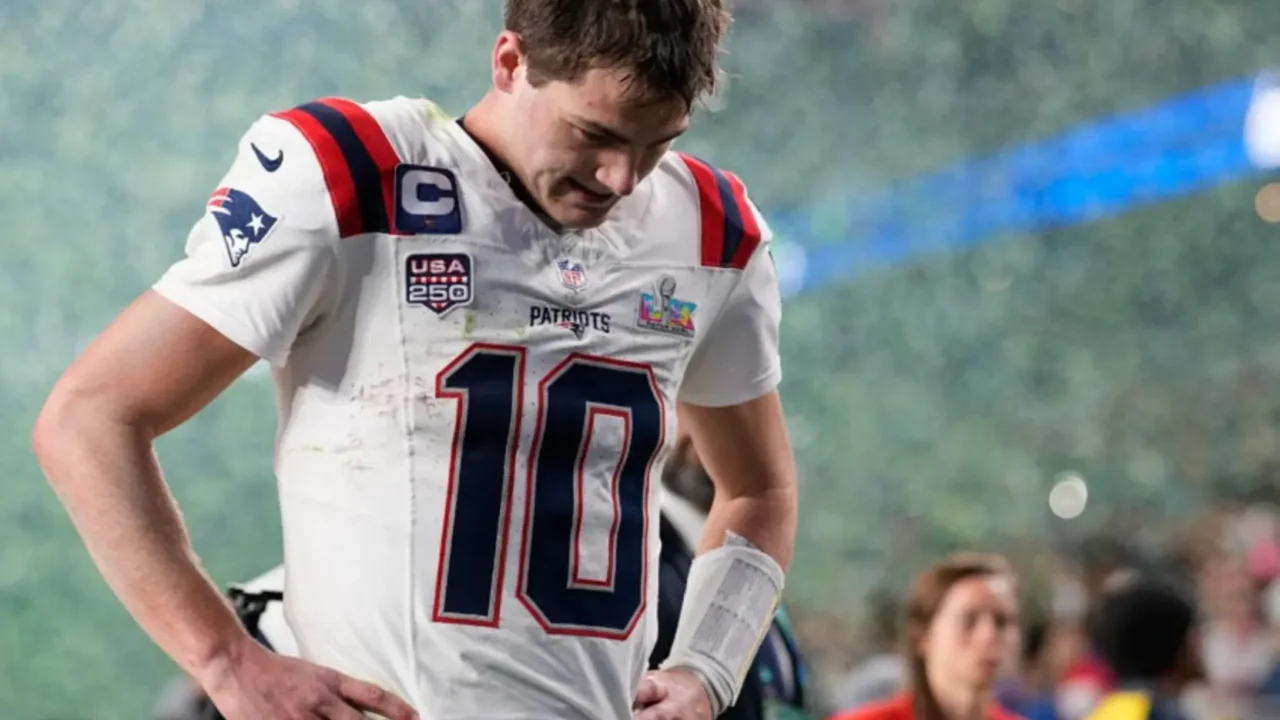
Drake Maye said he isn’t treating the Patriots’ season opener in Seattle on Wednesday, Sept. 9, 2026 as a “revenge game” even after New England’s Super Bowl LX defeat, a 29-13 loss at Levi’s Stadium that the club has referenced as a clear bar for improvement. Reporting and quotes in this story are grounded in Boston.com coverage by Conor Ryan (linked below).
“You get to say, you get a little bit of a, you get your revenge game, but I would not say revenge game. They won the big one, and we got to start the season off. You cannot get that game back that we lost, so we are onto something new,” Maye said.
How the Super Bowl ended: turnovers, sacks and immediate takeaways
The February loss at Levi’s Stadium still defines the immediate checklist for improvement. The final score was 29-13, and the box score highlighted two problem areas New England must address before the rematch.
First, Maye was charged with three total turnovers (two interceptions and a fumble). Second, New England’s offense allowed six total sacks, which repeatedly stalled drives and shifted field position. Those metrics—turnover margin and pass protection—were decisive in the outcome and are explicitly referenced in offseason planning and game preparation.
Addressing those issues is a mix of schematic adjustments, personnel changes and better execution under pressure. Limiting avoidable turnovers and improving communication on protection calls are short-term levers; deeper fixes include offensive-line continuity and clearer route concepts that reduce risk on contested throws.
Drake Maye’s mindset and what his quotes actually say
Maye framed the opener as a fresh start rather than an attempt to erase the Super Bowl result. His language emphasized learning and preparation over emotion-driven motivation: he described the rematch as an opportunity to see how offseason work translates to game situations rather than a moral reckoning.
He highlighted practical steps—joint practices, game-planning and getting looks at new personnel—that suggest a process-oriented mindset. That posture is noteworthy because quarterbacks who focus on execution and adjustments tend to manage high-pressure environments better than those who elevate the game into a narrative about revenge.
Technically, that doesn’t guarantee fewer mistakes, but it signals a coaching and player emphasis on reducing variance: cleaner protection, clearer reads, and prioritizing ball security on contested throws.
Roster changes that matter in the rematch
Maye referenced “new faces” that give the offense additional tools. New England’s offseason additions are presented in reporting as steps toward improving the pass-catch mix and bolstering protection, but these remain evaluative until they produce consistent, game-day results.
Boston.com frames A.J. Brown and Romeo Doubs as additions that could change the receiving distribution, while Vera-Tucker and Gilliam are viewed as ways to improve protection and blocking versatility. Those are reasonable expectations based on role and pedigree, but they should be read as cautious assessments rather than guarantees.
Coverage also flagged running-back depth and TreVeyon Henderson’s availability as a potential factor in short-yardage rotation and third-down packages. For more detail on that situation, see the team coverage on henderson new england patriots.
Matchup checklist: what to watch in Seattle
- Offensive-line performance: measurable reductions in pressures and sacks will be the clearest early sign of improvement.
- Pass rush replication: does Seattle consistently create heat, and how does Maye handle arrival timing and scramble opportunities?
- Lumen Field environment: crowd noise can complicate protections and cadence; note any pre-snap communication issues or false starts.
- New additions’ immediate impact: do A.J. Brown and Romeo Doubs influence coverage looks or create mismatches downfield?
- Ball security on contested throws and third-down conversion rate: concrete indicators that would show meaningful improvement from the Super Bowl.
Source & context: confirmed facts and remaining unknowns
This story is grounded in reporting by Conor Ryan / Boston.com, which provided Maye’s quotes and the roster details summarized above. Confirmed items in that reporting include the Super Bowl LX final score, the turnover and sack totals cited for the game, and Romeo Doubs’ reported contract.
What remains uncertain: how quickly new signings will adapt to the Patriots’ schemes, game-day health statuses, and whether protection improvements will be evident against a Seahawks front designed to pressure the quarterback. Those points are presented as informed assessments, not certainties.
Expect Week 1 in Seattle to be less about narrative closure and more about measurable progress: fewer turnovers, a cleaner sack sheet, and clearer evidence that offseason additions have altered coverage and protection dynamics. Maye’s comments underline that the team is treating the game as a benchmark for process-driven improvement rather than an emotional re-do.
Reporting credit: Conor Ryan, Boston.com — original story: Why Drake Maye doesn’t view rematch against Seahawks as a ‘revenge game’.