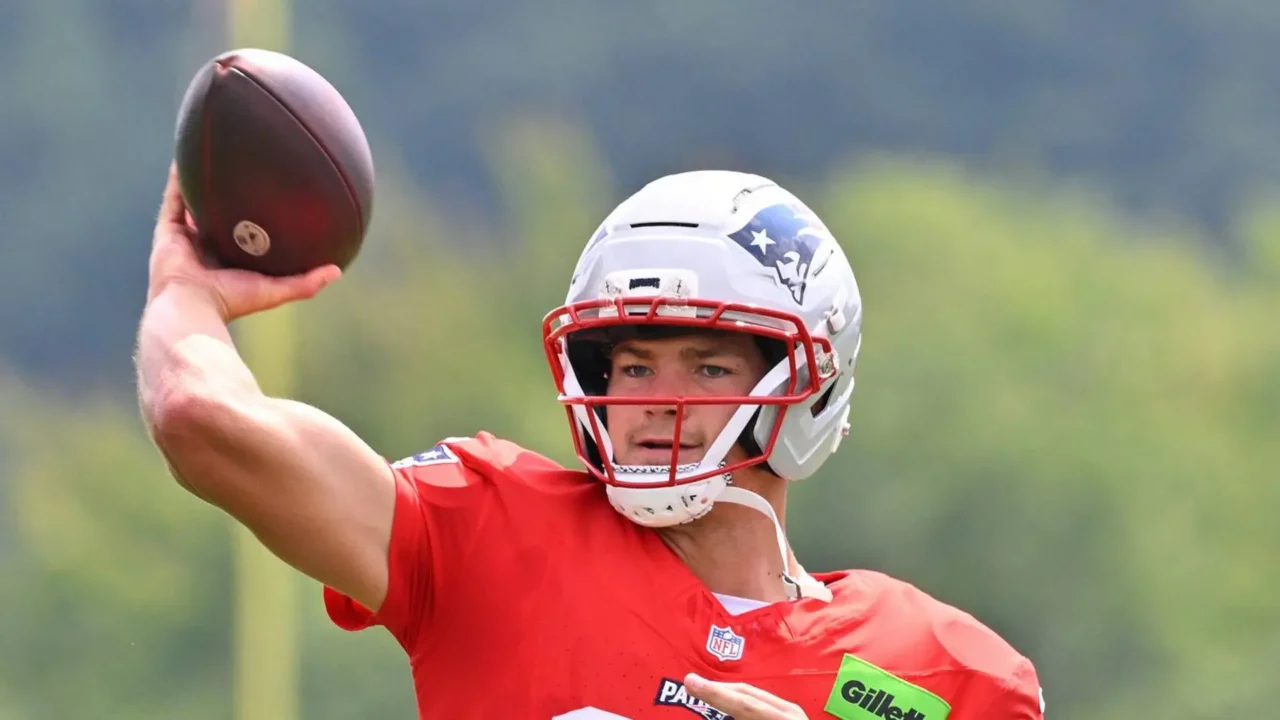
Drake Maye rates as one of the NFL’s best quarterbacks when facing pressure, according to an aggregation highlighted by Musketfire that cites analyst Scott Barrett. Barrett’s EPA-per-dropback snapshot — clean pocket (+0.36 EPA/DB) versus under pressure (-0.05 EPA/DB) — is the anchor data point reshaping how Patriots fans and evaluators should think about offseason urgency for the offensive line.
How Drake Maye performs under pressure
The Musketfire summary cites Scott Barrett’s three-year EPA-per-dropback aggregation and reports that Maye ranks second in the league on plays where he’s under pressure, trailing only Josh Allen and placed ahead of Patrick Mahomes in that snapshot. Exactly what Barrett combined and how he adjusted for opponent strength or situational context is not reproduced in Musketfire’s summary, so the ranking should be viewed as a directional indicator rather than a definitive forensic measure.
EPA per dropback (EPA/DB) attempts to quantify the expected point value added on a per-dropback basis; the clean-pocket number (+0.36) shows Maye is efficient when protection holds, while the under-pressure figure (-0.05) indicates he loses less value than most peers when the pocket collapses. That relative resilience under duress is what moves the needle for the Patriots’ offseason calculus: if the quarterback consistently mitigates the damage of pressure, the team can buy more time to evaluate and coach the offensive line rather than execute immediate, high-cost roster overhauls.
Important methodological caveats apply. Barrett’s aggregation covers multiple seasons and Musketfire does not publish the play-sample counts or the full charting rules behind the aggregation. Small sample effects, opponent mix, or clustering of pressured plays against certain defenses can shift rankings materially. In short: the ranking is meaningful but not conclusive.
Patriots’ offensive-line changes and the real roster risk
New England used this offseason to add players intended to improve protection. Interior veteran James Hudson, former high-upside starter Alijah Vera-Tucker, and rookie Caleb Lomu are all part of a rotation expected to stabilize the line after a year where rookie Will Campbell produced inconsistent play as a developmental starter. Those moves improve depth and competition but do not guarantee instant cohesion.
Barrett’s Maye ranking reduces the short-term downside of that uncertainty: if Drake Maye continues to generate positive outcomes when pressured, the Patriots can tolerate a slower ramp for the new line and rely more on schematic help. That changes the decision tree in the front office — fewer emergency veteran signings may be necessary, and the team can prioritize targeted coaching, continuity and graded preseason evaluation.
Still, the offensive line matters for more than limiting negative plays. Consistent pass protection sustains longer-developing concepts, opens lanes for the running game, and reduces turnover risk. If interior gaps or edge rush continuity issues reappear in training camp or preseason games, the team will need to pivot quickly — this analysis only softens, not eliminates, roster risk.
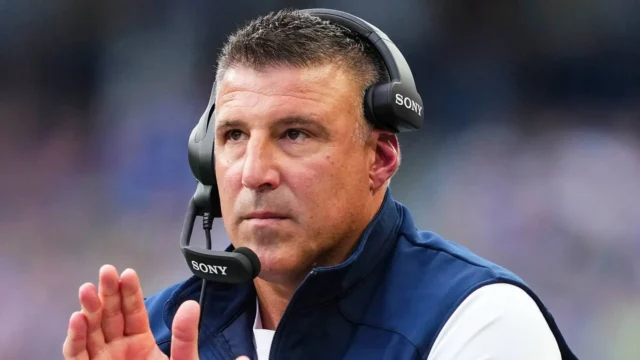
Continuity in coaching under Mike Vrabel and play-calling from Josh McDaniels provides a clearer runway to evaluate the group’s progress. See the Mike Vrabel Press Conference 6 9 coverage for how staff continuity and scheme choices factor into the OL development timeline.
Tactical implications for 2026 game planning
If the staff accepts Maye’s relative resilience as a planning assumption, practical play-calling adjustments follow. Quick game concepts, shorter internal reads, and high-percentage intermediate routes to weapons like A.J. Brown and Romeo Doubs reduce time-to-throw and exploit Maye’s ability to extend plays when needed. Play-action and lengthening-developing schematics can still be viable when paired with rotation-based protection schemes.
Opponent-specific protections will remain vital. Against premier edges, New England should consider slide protections, early micro-adjustments, max-protect personnel packages and more frequent rollout/boot concepts that use Maye’s mobility to change the launch point and simplify reads. Screens and quick RPOs are useful countermeasures when interior push threatens the pocket; those plays take pressure off linemen while creating movement for the run game.
Coaches should balance aggression and protection: leaning too heavily on quarterback improvisation risks turnovers and long-yardage drives, while overprotecting can blunt vertical passing game explosiveness. The most likely tactical path is a hybrid approach that favors quick distribution, selective max-protect on obvious third-and-long, and creative play-action when protection holds.
By the numbers (small table)
Conclusion: What this means — and what remains unclear
Scott Barrett’s EPA/DB snapshot, as reported by Musketfire, offers a plausible and useful thesis: Drake Maye‘s relative effectiveness under pressure reduces the immediate downside of an unproven Patriots offensive line and allows the team to prioritize measured evaluation, coaching continuity and targeted reinforcement over panic-signing a short-term veteran fix.
That said, the analysis is not a substitute for real-time evaluation. The Barrett ranking is aggregated and summarized by Musketfire without public methodology or play-sample disclosure. Training camp snaps, preseason protection grades, and early-season game tape remain the most important checkpoints. For longer-term planning — including cap and contract decisions tied to the quarterback’s trajectory — follow Patriots Report’s ongoing coverage on the drake maye contract discussion.
What remains unclear
- Exact play-sample sizes and Barrett’s charting methodology behind the EPA/DB aggregation.
- How the new offensive-line unit will perform together against early-season elite pass rushes and in short-yardage/third-and-long situations.
- Whether sustained pressure across a full NFL season will shift Maye’s EPA profile relative to a multi-year aggregation.
Source attribution: This article is based on the Musketfire summary “Drake Maye gives Patriots a safety blanket for their unproven offensive line” (Minute Media), which highlights an EPA-per-dropback aggregation by analyst Scott Barrett. Read the original report here: Musketfire. Patriots Report highlights Barrett’s aggregated EPA/DB figures but does not reproduce the underlying play charting, sample counts, or Barrett’s full methodology. Barrett’s ranking is his analysis and is not Patriots Report or Patriots team data.