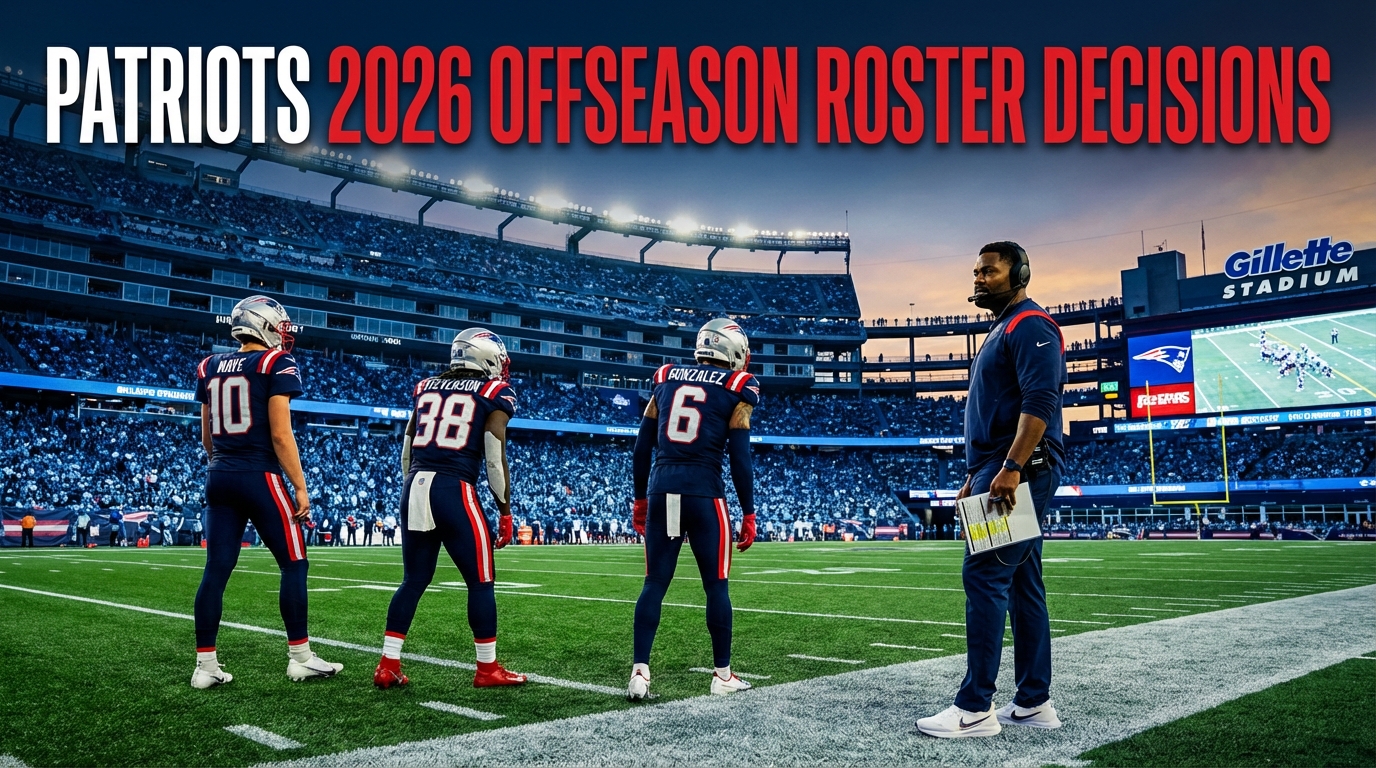
Patriots 2026 offseason roster decisions will define whether the franchise re-enters title contention or stalls rebuilding.
The stakes are high because salary cap choices and free agent signings shape the next three seasons. Fans and front office alike must weigh immediate gains against long-term flexibility.
This offseason matters especially for positions such as cornerback, defensive line, and running back. Moreover, contract year 2026 evaluations for players like Christian Gonzalez, Christian Barmore, and Antonio Gibson will demand hard calls. Therefore, the team must balance dead cap risks, guarantees, and potential extensions.
In this analysis we focus on starters who should not be re-signed. However, this is not simple roster pruning. We examine snap counts, age, cap hit, PFF grades, and replacement cost through the draft and free agency. As a result, readers will see why moving on from certain veterans could pay dividends. It may unlock a clearer path to Super Bowl contention.
Patriots 2026 offseason roster decisions: which starters should not be re-signed
The Patriots face tough choices in 2026 because cap space and roster construction collide. Therefore, the team must prioritize long term upside over short term comfort. This section outlines three starters who make the most sense to move on from, and why.
Christian Barmore — interior defensive line
Barmore remains a strong run defender, but his future cost and scheme fit create concerns. Spotrac projects interior defensive tackles to demand big money, and Barmore’s contract situation could push him toward a market that costs the team flexibility. Moreover, PFF grades show inconsistencies in pass rush productivity. Because the Patriots can replace interior minutes via the draft, keeping Barmore would risk cap strain.
Key points
- Age and trajectory raise doubts about long term ceiling.
- Replacement cost via the draft looks manageable.
- Financial risk if extension approaches $22.5 million per year.
Antonio Gibson — running back
Gibson produced reliably as a pass catcher and short yardage option. However, he profiles like a high usage back with declining efficiency. As a result, the Patriots should avoid extending a running back near free agency when younger options exist. Furthermore, running backs carry high injury risk, and an extension near $8 million annually would hamper flexibility.
Key points
- Declining per snap efficiency according to PFF metrics.
- Running back market volatility makes extensions risky.
- Draft and cheaper veteran options offer better value.
K’Lavon Chaisson or veteran edge rusher — re-evaluate re-signing
Edge rushers can change games, but guaranteed money and dead cap matter. Chaisson’s play has flash, yet consistency gaps show up in advanced metrics. If a re-sign involves heavy guarantees, the team should pass. Instead, they should shop for younger, cost-controlled options. For more on Chaisson’s free agency context, see K’Lavon Chaisson free agency with Patriots (re-sign)?
Key points
- Inconsistent PFF pass rush grades undermine expensive deals.
- Guaranteed money increases dead cap risk in later years.
- Younger edge prospects in the draft offer upside and lower cost.
Roster implications and cap architecture
Moving on from these starters would free space for extensions at priority spots. For example, reallocating a $22.5 million market-level DT contract and an $8 million RB deal could fund a premium corner or offensive line investment. As a result, the Patriots would keep core talents while adding youth.
For broader offseason strategy, reference the 2026 NFL Offseason Outlook Series and consider the AFC context in What does Beane, Williams mean for Bills, Dolphins, Patriots?
Sources

| Player Name | Age (2026) | Contract Status (dead cap and guarantees) | Performance Metrics (PFF highlights) | Projected Roster Impact |
|---|---|---|---|---|
| Christian Barmore | 26 | Potential market-level interior DT deal near $22.5 million per year if extended; multi-year guarantees would create long-term dead cap risk. | Strong run stop traits; inconsistent pass rush production on PFF. Grade profile shows high run-defense value but middling pass-rush grade. | Releasing or letting walk frees cap for a premium corner or offensive lineman. Draftable replacements exist, lowering cost of moving on. |
| Antonio Gibson | 27 | Running back market value could approach $8 million per year for a short-term deal; RBs often carry low guarantees, limiting dead cap but reducing flexibility. | Reliable receiving back with declining per-snap rushing efficiency per PFF. Pass-catching grades remain useful. | Letting him test market preserves cap to sign cheap depth. Draft or low-cost veterans can replicate production. |
| K’Lavon Chaisson | 29 | Future deal would likely include guaranteed money and year-one dead cap. High guarantee structure would increase risk on multi-year deals. | Flashy pass-rush flashes but inconsistent on PFF. Pass-rush win rate varies, and coverage grades lag. | Passing on a pricey re-sign allows investment in younger, higher-upside edge prospects. Team can target cheaper depth in free agency. |
Notes
- Financial figures are illustrative market ceilings to frame decision making. However, they show why guarantees and dead cap matter.
- Moving on from one or more of these starters could unlock funds for extension priorities elsewhere.
How the Patriots should use roster decisions to build their future
Deciding not to re-sign certain starters fits a clear roster construction plan. The Patriots can trade short term security for long term flexibility. This approach supports sustainable contention.
Cap management and Spotrac modeling
- Use saved cap space to fund priority extensions and free agent signings. Refer to Spotrac for cap modeling and market benchmarks.
- Passing on a near $22.5 million DT or an $8 million RB deal reduces future dead cap risk.
- Therefore, the team keeps room for inseason moves and sudden opportunities.
Analytics driven player evaluation
- Lean on PFF metrics to measure true on field value.
- Replace middling pass rushers who grade poorly with younger, higher upside talent.
- Because PFF highlights both run defense and pass rush, it helps prioritize which positions to invest in.
Draft capital and development
- Prioritize the draft for interior line and edge prospects. Rookies cost less and often outperform cheap veterans.
- Invest in player development to turn mid round picks into starters.
- Drake Maye needs weapons, so allocate funds to receiver and offensive line help.
Free agency and complementary signings
- Target low cost veterans who fit scheme and locker room culture.
- Avoid long term guarantees for high injury risk positions like running back.
- Use short term signings to bridge to younger starters.
Roster balance and core preservation
- Protect core players like Christian Gonzalez through targeted spending.
- Reallocating funds from fringe starters buys better coverage across the roster.
- Therefore, moving on helps keep a competitive window open for Super Bowl contention.
In sum, these moves trade immediate familiarity for controlled risk and future upside. The Patriots can use analytics, draft capital, and smart free agency to retool without sacrificing competitiveness.
Patriots 2026 offseason roster decisions will determine whether New England keeps cap flexibility and builds toward a true title window.
Moving on from select starters buys financial room and roster flexibility. Therefore, the team can protect core pieces and invest in high impact areas. For example, avoiding a market level $22.5 million interior defender or an $8 million running back deal preserves funds for cornerback help and offensive line upgrades.
This strategy reduces dead cap risk and increases draft leverage. As a result, the Patriots can add younger, higher upside players through the draft and low cost free agency. However, it requires disciplined scouting and smart development.
Patriots Report LLC provides detailed analytics and clear context to this approach. For ongoing coverage and roster modeling, see the site and follow the conversation on Twitter at @ZachGatsby. Trusting process, analytics, and cap prudence gives the team the best shot at sustained contention.
Frequently Asked Questions (FAQs)
What are the most important Patriots 2026 offseason roster decisions?
– Prioritize cap flexibility and protect core players. Because contracts and guarantees shape future windows, the team must balance short term wins with long term health. Therefore, decisions about interior defensive line, running back, and edge help rank high. The front office should set spending limits and stick to them.
Which starters are likeliest not to be re-signed?
– Candidates include players with costly market value, middling PFF grades, or high injury risk. For example, Christian Barmore, Antonio Gibson, and K’Lavon Chaisson fit those profiles. However, actual moves depend on market interest and guaranteed money demands.
How do these moves affect salary cap and dead cap?
– Letting a player walk can free immediate cap space. Conversely, cutting a player with heavy guarantees creates dead cap. Spotrac modeling shows avoiding a market level $22.5 million DT deal or an $8 million RB contract preserves flexibility. As a result, the team can fund priority extensions.
Can the Patriots replace veterans through the draft or free agency?
– Yes. Drafting interior line and edge prospects provides cost controlled options. Moreover, short term veteran signings can bridge gaps. Because Drake Maye will need weapons, reallocating funds to receivers and offensive line makes strategic sense.
What are the risks and rewards of moving on from starters?
– Reward: increased cap room, draft capital, and younger upside. Risk: short term depth loss and potential production drop. With disciplined scouting and clear spending rules, rewards should outweigh risks.