Patriots playoff officiating advantage vs Texans: Late game breaks that can decide the divisional round
Few things swing a playoff game like a turnover in the final minutes. Because one forced fumble or one questionable call can flip momentum, teams and fans feel every whistle. Patriots playoff officiating advantage vs Texans matters for that reason, and it deserves careful scrutiny. Therefore we examine how the head official and his crew could affect field position, drive outcomes, and ultimately, the result.
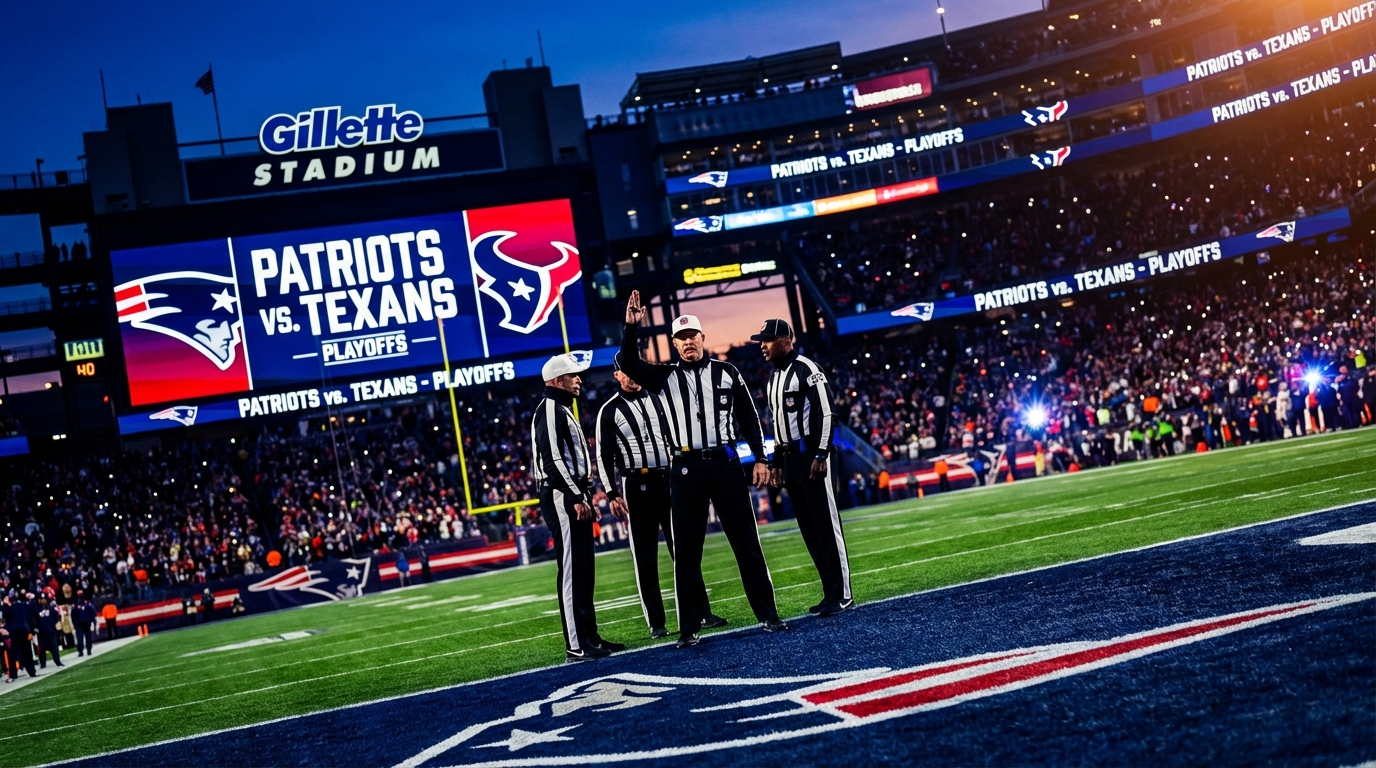
The Patriots enter the divisional round with a defense that thrives in short fields. However, the referee assignment raises questions. Shawn Smith will patrol the game, and his crews have called more penalties on away teams, 107 to 80. As a result, the home team has won 80 percent of games he has worked. Those trends do not prove bias, but they do create meaningful context for New England.
We write with caution and with a slant favoring the Patriots. Still, the team must prepare for every scenario. Next, the article will analyze penalty breakdowns, situational fouls, and how to reduce officiating impact.

Patriots playoff officiating advantage vs Texans: Shawn Smith and his crew
Shawn Smith will serve as the head official for the divisional round. Because his crews have a clear calling pattern, that assignment matters. Smith and his team have assessed 107 penalties on away teams versus 80 on home teams. As a result, home teams have won 80 percent of games he has worked. Those numbers do not prove bias, but they create a meaningful backdrop for New England.
Key tendencies and how they affect outcomes
- Penalty distribution: Smith’s crews flag away teams more often. Therefore, visiting teams risk repeated preclusive calls that stall drives.
- Timing of calls: Officials often make game-changing calls late. Because playoffs hinge on the final minutes, a late flag can swing momentum dramatically.
- Field position impact: More penalties on the visitor usually mean shorter fields for the home team. As a result, the defense faces tougher situations.
- Home crowd and crew dynamics: Home fans can influence perception. However, responsible crews should remain impartial.
- Win rate correlation: An 80 percent home-team win rate under Smith raises questions. Still, correlation does not equal causation.
What this means for the Patriots
The Patriots enter the game with a defense built for short fields. Therefore they benefit when opponents give up yards or turnovers after flags. However, New England cannot rely on the officials to decide the game. The team must control penalties and force clean turnovers. In short, the referee assignment provides context but not a guarantee. Prepare, stay disciplined, and let the defense make the plays.
PENALTY AND WIN STATISTICS FOR KEY OFFICIALS
| Official Name | Away Team Penalties | Home Team Penalties | Home Team Win Rate | Notable Games Officiated |
|---|---|---|---|---|
| Shawn Smith | 107 | 80 | 80% | 2026 divisional round: Patriots vs Texans; multiple regular-season and postseason games |
| League playoff average (recent seasons) | Varied; roughly balanced | Varied; roughly balanced | Approximately 50% | Multiple postseason crews (aggregate) |
| Recent Patriots playoff officials (aggregate) | Varies; not consistently tracked | Varies; not consistently tracked | Varies by official | Includes officials assigned to Patriots postseason games in recent years |
Note: Smith’s numbers are documented in officiating logs. League-wide splits are less consistently reported, so aggregated rows are meant as contextual reference.
How Patriots playoff officiating advantage vs Texans could shape late-game moments
Late-game officiating can decide playoff results. Because Smith and his crew have a documented calling pattern, their presence matters. “Smith and his crew have been much more favorable toward home teams,” which creates a real concern. However, numbers alone do not prove intentional bias. Still, trend lines matter in tight games.
How crew tendencies translate into decisive moments
- Penalty timing matters. A holding or pass interference flag late can erase a turnover or extend a drive. Therefore the call often changes field position.
- Away team flags add up. Because Smith’s crews called 107 away-team penalties and 80 on home teams, visitors risk repeated setbacks.
- Replay and challenges interact with officiating. As a result, coaches must pick their challenges carefully.
- Subjective fouls become pivotal. However, roughing and targeting calls in the final minutes have outsized effects.
- Crowd noise and pressure can shape perception. Thus, crews may face harder looks on close plays at home.
Late turnover scenarios and likely impact
- Forced fumble on a strip: If recovered by the Patriots, a late flag could negate the play. Therefore the home team may avoid a turnover via a penalty call.
- Interception returned for a score: A controversial block or illegal contact flag can nullify the return. As a result, turnovers may not stand.
- Boundary plays and out-of-bounds rulings: Because these calls are often tight, they swing clock and possession.
What New England should do
The Patriots must minimize penalties and practice endgame discipline. The team should avoid risky blocks and hold crisp positioning. “The Patriots cannot afford to have their game messed with by the referees,” so preparation matters. Coaches must plan for replay strategy and timeout use. Ultimately, execution on the field remains the decisive factor.
Conclusion: Officiating and the Patriots’ edge
Officiating trends can tilt playoff games when margins shrink. Because Shawn Smith’s crew has shown a pattern favoring home teams, those trends matter. The Patriots playoff officiating advantage vs Texans remains a contextual edge, not a guarantee. Fans should note the numbers and still expect a contested game.
Late turnovers and lucky breaks become decisive in the final minutes. A late holding, pass interference, or roughing flag can erase a turnover or extend a drive. Therefore New England’s discipline will determine if the edge turns into a win. The Patriots’ defense and situational awareness keep them favored, and coaching must emphasize clean execution.
Plan for replay strategy and timeout use. As a result, coaches who manage those elements better can protect outcomes. Still, the players must make the plays that matter.
For more focused breakdowns and real-time takeaways, follow Patriots Report LLC. Visit patriotsreport.com and follow @ZachGatsby on Twitter/X for further insight. Stay engaged, trust the preparation, and let the final minutes decide who earns the next step.
Frequently Asked Questions
What are Shawn Smith’s crew tendencies?
Smith’s crew has called 107 penalties on away teams and 80 on home teams. Because away teams draw more flags, visitors often face tougher field position. However, numbers do not prove bias. They do give context for late-game strategy.
How could these tendencies influence the Patriots vs Texans game?
The Patriots playoff officiating advantage vs Texans shows up in short fields and late calls. A late holding or pass interference can erase a turnover. Therefore coaches must manage challenges and clock.
Do home team win rates under Smith mean officials decide games?
Not necessarily. Home teams have won 80% of games he worked, but correlation is not causation. Still, trends matter when games are close. Players and coaches must control what they can.
How should the Patriots prepare for potential officiating impacts?
Practice discipline, avoid unnecessary penalties, and rehearse endgame scenarios. Use timeouts and challenges wisely. As a result, the team reduces opportunities for lucky breaks to swing the game.
What should fans watch for during the divisional round?
Watch penalty timing, replay outcomes, and field position shifts after flags. Also track subjective calls late in the game. These moments often determine playoff outcomes.